AI estimate as of June 23, 2025 · verify with a professional before acting
AI-Generated · Verify before acting
Everything on this page is generated by AI for informational purposes only. AI can make mistakes — the AI may misidentify items or misattribute them (artist, maker, brand, designer, origin, era). This is not an official valuation and should not be used for insurance, sale, tax, estate, legal, or lending purposes — or any decision requiring a certified appraisal. It is not an authoritative claim about any person, brand, or rights holder — do not share or rely on it as a factual statement about a third party. Always consult qualified professionals before making financial decisions.
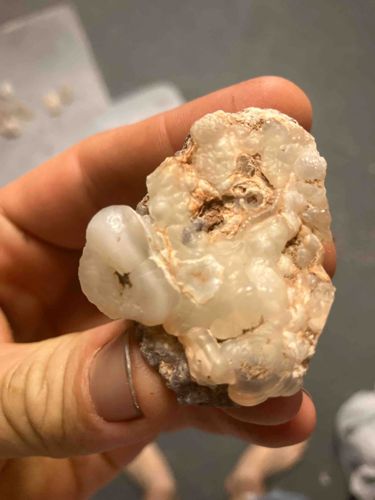
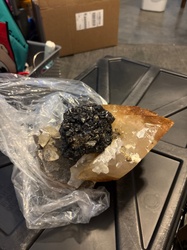
This item is a raw mineral specimen, likely a botryoidal chalcedony or agate formation, presented on its natural matrix. Physical characteristics include a dominant whitish to translucent milky color, with some areas exhibiting a very light cream or yellowish tint. The surface of the chalcedony displays distinct botryoidal (grape-like) formations, characterized by numerous rounded, bubble-like lobes clustered together, giving it a bumpy, organic texture. Some of these lobes appear semi-transparent, allowing a hint of the underlying matrix to be seen. The matrix itself appears to be a darker, earthy-toned rock, possibly a type of basalt or other igneous/metamorphic rock, with shades of brown, gray, and possibly traces of reddish-brown iron staining visible where the chalcedony does not completely cover it. The overall size is held comfortably within a human hand, suggesting it is a small to medium-sized specimen, perhaps 2-4 inches in its longest dimension. There are no visible condition issues such as major cracks, chips, or repairs; the piece appears to be in its natural state, showing only the typical rough edges and textural variations inherent to a natural mineral formation. No distinguishing markings, maker's marks, or signatures are discernible, as is common with raw geological specimens. Its formation suggests a natural geological process over a long period, making its age ancient. The quality indicators point to a well-formed botryoidal habit with good luster for a natural chalcedony, signifying a desirable piece for mineral collectors. The contrast between the translucent white botryoidal growths and the darker host rock enhances its visual appeal.
AI Appraisal Report
I have examined the provided image of this botryoidal chalcedony on matrix. The specimen presents as a natural, raw mineral, characterized by prominent whitish to translucent milky botryoidal formations clustered on a darker, earthy-toned matrix. The "grape-like" habit is well-defined and exhibits good luster, enhancing its aesthetic appeal. Based on the visual evidence, the condition appears excellent, with no visible chips, cracks, or repairs. The piece seems to be in its natural state, which is highly desirable for collectors. Authenticity, based solely on visual inspection of the image, appears strong as a natural geological formation. The typical texture and formation patterns align with known botryoidal chalcedony specimens.In terms of market conditions, well-formed botryoidal chalcedony specimens, especially those on an attractive matrix, are consistently sought after by mineral collectors. Comparable pieces of similar size and quality often retail from specialized mineral dealers or at gem and mineral shows. Demand for unique and aesthetically pleasing natural specimens remains steady. While botryoidal chalcedony itself isn't exceptionally rare globally, specimens of this quality, exhibiting a distinct contrast between the chalcedony and matrix, are less common.The factors significantly impacting its value include the well-developed botryoidal habit, the appealing translucent quality of the chalcedony, and its natural presentation on the matrix. The size, estimated to be comfortably handheld, makes it suitable for display.The primary limitation in authentication from an image alone is the inability to conduct tactile examination for weight, texture variations, or to perform specific gravity tests. For full authentication, a physical examination would allow for precise measurements, a stereomicroscopic inspection to confirm crystalline structure and rule out synthetics or highly processed specimens, and potentially X-ray diffraction (XRD) if there were any doubts about mineral composition. Provenance documentation, detailing the specimen's origin, would also add to its verifiable history, although this is less common for raw mineral specimens unless they are from historically significant localities. Based on current market trends and the visual quality, I would appraise this specimen within a collector's range.