AI estimate as of August 29, 2025 · verify with a professional before acting
AI-Generated · Verify before acting
Everything on this page is generated by AI for informational purposes only. AI can make mistakes — the AI may misidentify items or misattribute them (artist, maker, brand, designer, origin, era). This is not an official valuation and should not be used for insurance, sale, tax, estate, legal, or lending purposes — or any decision requiring a certified appraisal. It is not an authoritative claim about any person, brand, or rights holder — do not share or rely on it as a factual statement about a third party. Always consult qualified professionals before making financial decisions.
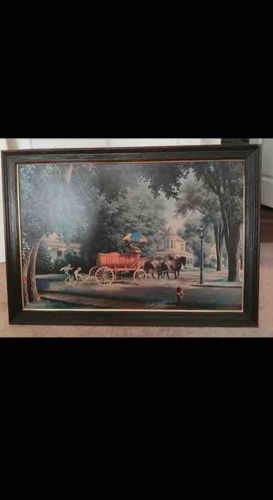
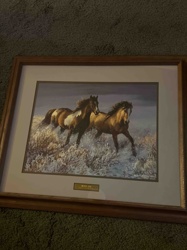
The item is a framed art print depicting a pastoral or rural street scene. The overall dimensions are not provided, but it appears to be a medium to large-sized rectangular piece, oriented horizontally. The print itself is a colorful depiction featuring a red horse-drawn wagon in the center, pulled by two dark-colored horses. A dog is visible near the front of the wagon, and a small child stands to the right of the wagon. The background shows lush green trees, suggesting a verdant landscape, with what appear to be large, traditional-style houses or buildings visible through the foliage, indicative of an older architectural period. A street lamp is also visible on the right side. The colors are generally muted but naturalistic, dominated by greens, browns, and the striking red of the wagon. The print is housed Glazed and framed in a dark, possibly wooden frame with a visible, narrow gold-colored inner fillet or liner, which provides a subtle contrast against the darker frame and the print itself. The construction of the frame appears robust, suggesting a professional framing job. There are no immediately apparent signs of significant damage to the print itself, such as tears, creases, or major discoloration, although the resolution of the image makes a detailed condition assessment challenging. The frame seems largely intact, with no obvious cracks or breaks, though minor scuffs or wear consistent with age and handling would be expected. Without visible artist signatures, edition numbers, or maker's marks on the front, specific manufacturing details are unknown. The style suggests it could be a reproduction of an 18th, 19th, or early 20th-century American or European rural genre scene, indicating a potential age that is several decades old, likely produced in the mid to late 20th century. The quality of the print appears good, with decent color saturation and detail for a mass-produced item.
AI Appraisal Report
Based on my visual examination of the provided image, this item is a framed art print depicting a horse-drawn wagon street scene. The print appears to be in good condition, showing no obvious signs of major tears, creases, or significant discoloration. The colors, while muted, seem consistent. The frame, a dark, likely wooden piece with a gold-colored inner fillet, also appears largely intact with no visible breaks, though minor scuffs or wear consistent with age are probable. The glazing seems clear. This arrangement suggests a professionally framed reproduction.
Market conditions for such mass-produced art prints of rural/pastoral scenes are generally modest. They fall into a decorative art category rather than fine art. Comparable sales of similar decorative framed prints by unknown artists or as reproductions typically range from $25 to $150, depending on size, framing quality, and aesthetic appeal. The charm of the scene (horse-drawn wagon, dog, child) and the quality of the framing elevate it slightly within this range.
Demand for this specific genre is stable but not high, primarily for home décor. Rarity is low, as these prints were often produced in large quantities. Factors significantly impacting value are primarily the decorative appeal and the condition of both the print and the frame.
It is crucial to note that this is an appraisal based solely on visual examination of an image. Authenticity verification is severely limited without physical inspection. To fully authenticate, I would need to physically examine the item to check for artist signatures, edition numbers, print quality (e.g., dot patterns indicative of reproduction vs. original printmaking techniques), paper type, and framing details. Provenance documentation, if available, would also be invaluable. Scientific testing (e.g., pigment analysis, paper dating) would be required for definitive dating or advanced authentication beyond a visual assessment.