AI estimate as of September 18, 2025 · verify with a professional before acting
AI-Generated · Verify before acting
Everything on this page is generated by AI for informational purposes only. AI can make mistakes — the AI may misidentify items or misattribute them (artist, maker, brand, designer, origin, era). This is not an official valuation and should not be used for insurance, sale, tax, estate, legal, or lending purposes — or any decision requiring a certified appraisal. It is not an authoritative claim about any person, brand, or rights holder — do not share or rely on it as a factual statement about a third party. Always consult qualified professionals before making financial decisions.
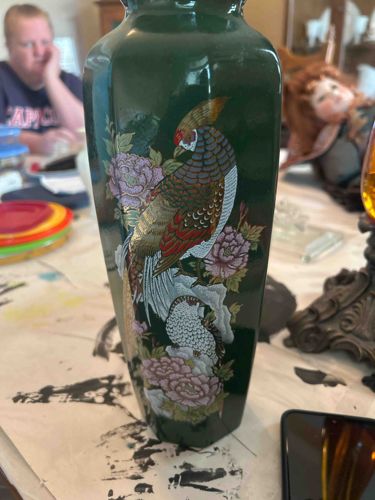
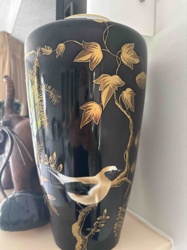
This is a ceramic vase, predominantly dark green in color, giving it a rich and somewhat opulent appearance. The vase features a slightly flared rim at the top and a relatively narrow neck before widening into a cylindrical or ovoid body. The most striking characteristic is the intricate, polychrome decoration adorning its surface. A central motif depicts a stylized pheasant with vibrant plumage, including shades of deep red, orange, gold, light blue, and greyish-white detailed feathers. The pheasant appears to be perched among an arrangement of flowers, primarily peonies or similar large, multi-petaled blossoms, rendered in soft hues of purple, pink, and off-white, interspersed with green foliage. The painting style appears to be a form of enamel or overglaze decoration, possibly depicting an Asian aesthetic, reminiscent of traditional Chinese or Japanese porcelain work. The surface of the vase has a visible sheen, suggesting a glazed finish, which contributes to its elegant look. There are no immediate visible cracks, chips, or significant wear, though some dust or minor surface grime might be present. The craftsmanship suggests it is a decorative piece, likely intended for display rather than heavy utility. Its style hints at a possible mid-20th century to contemporary manufacturing, though without a clear maker's mark or more contextual information, precise dating is challenging. The overall impression is one of a carefully crafted decorative object with a traditional, nature-inspired design.
AI Appraisal Report
This dark green ceramic vase, adorned with a vibrant pheasant and floral motif, presents as a charming decorative object. Visually, its condition appears to be good, with no obvious chips, cracks, or significant wear that would detract from its aesthetic appeal. The glazed finish contributes to its elegant look, and the polychrome decoration, reminiscent of an Asian aesthetic, is executed with a fair degree of detail. The vibrancy of the colors in the pheasant's plumage and the soft hues of the peonies are quite attractive.
Based on the description of the design and overall finish, I assess this as a mass-produced or semi-mass-produced decorative item, likely from the mid-20th century to contemporary manufacturing, as you noted. The style, while traditional, lacks the intricate brushwork, potting precision, and age-related characteristics that would suggest antique or highly collectible value. Comparable pieces of this type, often found in estate sales or online marketplaces, typically fall within a modest price range.
Demand for such decorative vases is generally steady but not exceptionally high, and they are not considered rare. Factors that significantly impact value would include verifiable provenance, a recognized maker's mark, or superior artistic execution – none of which are evident from the description. Without an in-person examination, I cannot definitively confirm the material quality beyond 'ceramic' or detect subtle restoration work or hairline fractures. Full authentication would require examining any base marks, assessing the body's weight and feel, and potentially examining the painting technique under magnification to confirm whether it's hand-painted enamel or a decal. Without this, the value remains in the decorative arts category rather than fine art or antique collectibles.