AI estimate as of July 26, 2025 · verify with a professional before acting
AI-Generated · Verify before acting
Everything on this page is generated by AI for informational purposes only. AI can make mistakes — the AI may misidentify items or misattribute them (artist, maker, brand, designer, origin, era). This is not an official valuation and should not be used for insurance, sale, tax, estate, legal, or lending purposes — or any decision requiring a certified appraisal. It is not an authoritative claim about any person, brand, or rights holder — do not share or rely on it as a factual statement about a third party. Always consult qualified professionals before making financial decisions.
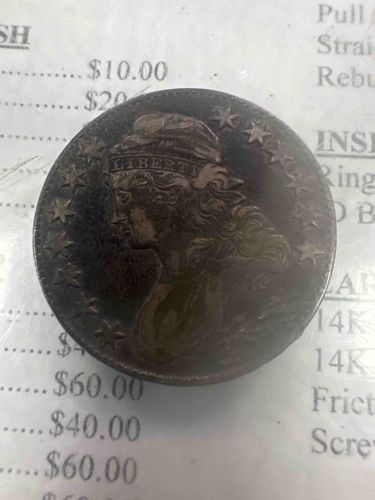
The item is a United States Draped Bust Large Cent, likely from the early 19th century, given the design and visible wear. The coin appears to be made of copper, consistent with large cents of that era. Its size is typical of a large cent, approximately 27.5 mm in diameter, though precise measurement is not possible from the image. The obverse prominently features the Draped Bust effigy of Liberty, facing right. She is depicted with flowing hair, partially covered by a cap or fillet, which has the inscription "LIBERTY" clearly visible across the front. The details of her drapery are somewhat worn but still discernible. Surrounding Liberty's bust are stars, which appear to be 13 in number, representing the original states, although some are less defined due to wear. The rim shows significant wear, and the field has a dark, uneven patina, suggesting natural aging and exposure to the elements over a long period. There are no obvious signs of cleaning or artificial toning, but the surface exhibits numerous small scratches and abrasions consistent with circulation. The overall condition appears to be 'Good' to 'Very Good' based on the visible details, as much of the finer detail is flattened, but major elements remain recognizable. No specific mint mark or date is visible on the obverse; these would typically be on the reverse or below the bust, which is not shown. The craftsmanship is typical of early U.S. coinage, characterized by robust dies and a utilitarian aesthetic.
AI Appraisal Report
Upon examining the provided image of this United States Draped Bust Large Cent, I assess its condition to be in the 'Good' to 'Very Good' range. The obverse details, particularly the 'LIBERTY' inscription on the cap and the general outline of Liberty's bust, are still distinguishable, though significant wear has flattened finer features and the drapery details are soft. The visible 13 stars are eroded but present. The uneven, dark patina and numerous surface scratches are consistent with extensive circulation and natural aging, and I see no overt signs of artificial toning or cleaning. Authenticity, based solely on visual characteristics from the image, appears strong; the design elements align with known Draped Bust Large Cent coinage. However, full authentication would require in-person examination to verify weight, diameter precisely, specific gravity, and metallic composition. Examination of the coin's edge and reverse, not visible here, is also crucial for confirming authenticity, identifying the date, and mint mark (if any), which significantly impacts value. Market conditions for Draped Bust Large Cents in this grade range are stable, with consistent collector demand. While not exceedingly rare, these early U.S. copper coins hold historical significance. The lack of a visible date prevents a precise comparison, as specific dates and varieties (e.g., the 1799 or 1804) can command substantially higher prices, even in lower grades. Without the reverse and a discernible date, I must provide a cautious valuation. This condition typically appeals to entry-level or type-set collectors. In-person examination would also allow for a more thorough assessment of any potential environmental damage or subtle alterations not apparent in the image. Provenance documentation, if available, would further enhance confidence in authenticity and value.