These notes were written by the person who submitted this item. Appraiser.AI has not verified them, and the AI's identification and estimate may rely on them.
AI Estimated Value
Not an official valuation
$150-250
AI estimate as of November 6, 2025 · verify with a professional before acting
AI-Generated · Verify before acting
Everything on this page is generated by AI for informational purposes only. AI can make mistakes — the AI may misidentify items or misattribute them (artist, maker, brand, designer, origin, era). This is not an official valuation and should not be used for insurance, sale, tax, estate, legal, or lending purposes — or any decision requiring a certified appraisal. It is not an authoritative claim about any person, brand, or rights holder — do not share or rely on it as a factual statement about a third party. Always consult qualified professionals before making financial decisions.
This analysis also relies on unverified notes provided by the user, which may be incomplete or inaccurate and could affect the result.
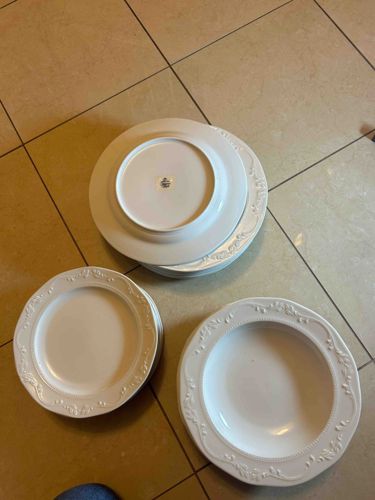
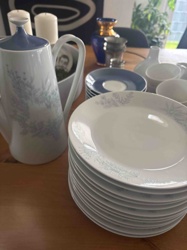
This collection of dinnerware consists of plates and bowls, likely part of a larger set, in the 'Huguenot Royale White' pattern. The items are made of a classic white ceramic or porcelain material, presenting a clean and elegant appearance. The design features a delicate, raised embossed border with a repeating floral or foliate motif, accented by a subtle beaded or dotted edge just inside the main rim. The larger plates, seen stacked, reveal a slightly scalloped or octagonal shape to their outer edge, enhancing their ornamental quality. The smaller plates also exhibit the same embossed rim design. One large, deep bowl or pasta plate is clearly visible, maintaining the consistent decorative border. On the underside of one of the plates, a manufacturer's mark is visible, which appears to be a small rectangular or shield-shaped label with text, confirming the 'Huguenot Royale White' identity. This mark likely provides details about the maker and pattern. The overall condition appears to be good; no significant chips, cracks, or heavy signs of wear are immediately apparent from the provided images, suggesting they have been well-maintained or are relatively new. The craftsmanship indicates a refined production process, creating a durable yet aesthetically pleasing dinnerware suitable for both everyday use and special occasions. The style leans towards a traditional or transitional aesthetic, likely produced in the late 20th or early 21st century.
AI Appraisal Report
Based on my visual examination of the provided images, this Huguenot Royale White Dinnerware Set presents well. The condition appears to be good with no obvious chips, cracks, or significant wear visible, suggesting careful use or relative newness. The embossed floral/foliate pattern with a beaded edge is consistent with the 'Huguenot Royale White' line, and the visible manufacturer's mark on the underside reinforces authenticity. The slightly scalloped/octagonal shape of the larger plates adds a touch of design interest.
Market conditions for white ceramic or porcelain dinnerware, even from established patterns, are generally moderate. While 'Royale White' is a known pattern, it does not typically command premium antique or collectible pricing unless it's a complete, pristine, large service. Comparables for similar mid-tier, white embossed dinnerware sets suggest that individual pieces or smaller partial sets like this typically sell within a modest range. Demand for general white dinnerware remains steady for everyday use or casual entertaining, but rarity is not a significant factor here; it's a commonly produced style. Factors impacting value positively are the apparent good condition and the consistent aesthetic. However, the lack of a full set count, specific piece types (e.g., serving pieces, cups, saucers), and confirmed piece quantities limits a higher valuation.
It is important to state that this appraisal is based solely on photographic evidence. For a full authentication and more precise valuation, an in-person examination would be critical to thoroughly check for hairline cracks, subtle glaze imperfections, knife marks, utensil wear, and to confirm the exact material composition and full count of all pieces. Provenance documentation, such as original purchase receipts or detailed inventory lists, would also further solidify authenticity and condition claims. Without these in-person verifications, the valuation reflects the potential condition observed in the images, assuming no hidden defects.