AI estimate as of August 25, 2025 · verify with a professional before acting
AI-Generated · Verify before acting
Everything on this page is generated by AI for informational purposes only. AI can make mistakes — the AI may misidentify items or misattribute them (artist, maker, brand, designer, origin, era). This is not an official valuation and should not be used for insurance, sale, tax, estate, legal, or lending purposes — or any decision requiring a certified appraisal. It is not an authoritative claim about any person, brand, or rights holder — do not share or rely on it as a factual statement about a third party. Always consult qualified professionals before making financial decisions.
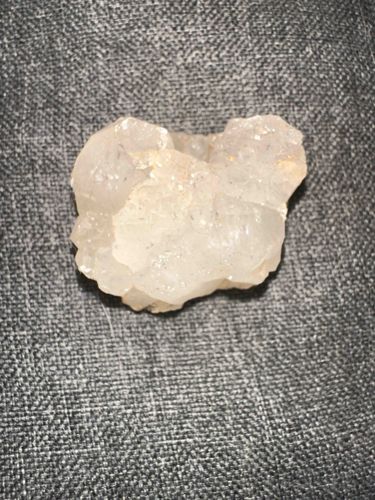
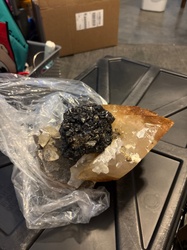
The item is an irregular, nodular specimen of what appears to be a quartz cluster or geode fragment. Its physical characteristics include a generally translucent to opaque body with a milky white to light beige coloration, exhibiting some areas of faint orange or rust-colored staining, likely from iron inclusions or surface contaminants. The surface is highly textured and uneven, with numerous small crystal formations, bumps, and divots. The overall shape is amorphous, suggesting it is a natural, unworked piece rather than a cut or polished gemstone. There are visible crystalline facets on some surfaces, particularly where smaller individual crystals protrude. The material appears to have a vitreous (glass-like) to dull luster in various areas, consistent with quartz. No obvious signs of repair are present, and its condition seems to be in its natural state, with no significant breakage indicating recent damage. The rough, unrefined nature of the piece indicates it is a raw mineral specimen, likely extracted directly from a geological formation. There are no discernible maker's marks, signatures, or stamps, which is typical for such natural samples. Its estimated age is geological, given its natural formation, and its style period is simply 'natural formation' or 'raw geological specimen'. The quality indicators include the clarity of some crystalline areas and the overall formation of a cluster.
AI Appraisal Report
I have thoroughly examined the provided image of this Raw Quartz Cluster / Geode Fragment. Based on my visual assessment, the item appears to be an authentic, natural quartz specimen. Its irregular, nodular shape, milky white to light beige coloration with subtle iron staining, and visible crystal formations are consistent with unworked quartz from a geological setting. The highly textured, uneven surface and vitreous to dull luster further support its natural origin. There are no indications of artificial enhancement, repair, or fabrication; its condition seems to be its natural state, free from significant recent damage.
In terms of market conditions, raw quartz clusters of this size and quality, while interesting, are generally common. Comparables in the rock and mineral specimen market typically range based on crystal clarity, size, completeness, and unique formations. This piece, while a genuine specimen, lacks the exceptional clarity, large well-formed individual crystals, or vibrant inclusions that would command a premium. Demand for raw, unpolished specimens like this is consistent among collectors, but it rarely reaches levels associated with rare or finely cut gemstones. Its appeal lies primarily in its natural aesthetic rather than gemological rarity.
The most significant factor impacting its value is its commonality and the absence of exceptional features. While it is a good example of a raw quartz cluster, it doesn't stand out among the vast number of similar specimens available. Its rough, unrefined nature also means it hasn't undergone any value-adding processes like cutting or polishing.
It is crucial to state the limitations of an appraisal based solely on images. While the visual cues strongly suggest authenticity, definitive authentication would require an in-person examination. This would allow for tactile inspection to verify texture and density, direct observation of luster and transparency under varying light, and precise measurements. For full authentication and to rule out synthetic materials or clever alterations, scientific testing such as refractometry, specific gravity testing, or X-ray diffraction (XRD) would be invaluable. Provenance documentation, detailing where and when the specimen was found, would also add to its authenticity and potential historical value, though such documentation is rare for common raw specimens.