AI estimate as of September 9, 2025 · verify with a professional before acting
AI-Generated · Verify before acting
Everything on this page is generated by AI for informational purposes only. AI can make mistakes — the AI may misidentify items or misattribute them (artist, maker, brand, designer, origin, era). This is not an official valuation and should not be used for insurance, sale, tax, estate, legal, or lending purposes — or any decision requiring a certified appraisal. It is not an authoritative claim about any person, brand, or rights holder — do not share or rely on it as a factual statement about a third party. Always consult qualified professionals before making financial decisions.
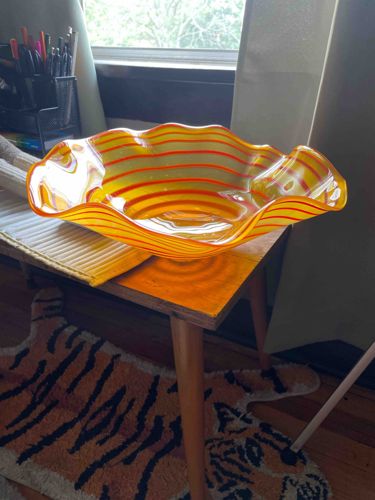
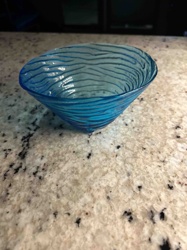
This is a vibrant art glass bowl, likely of Murano or Murano-style origin, characterized by its distinctive scalloped, wavy rim and broad, shallow form. The bowl is made of translucent glass, primarily a bright yellow or amber color, through which runs a pattern of horizontal orange-red stripes. These stripes are consistently spaced and appear to be embedded within the glass, indicating a complex manufacturing process typical of layered or cane glass techniques. The transparency of the glass allows light to pass through, creating an attractive glow, especially where the colors overlap or are denser. The physical characteristics suggest it is large enough to serve as a centerpiece or decorative fruit bowl. The edges of the bowl are intentionally irregular and wavy, giving it an organic, free-form aesthetic. There are no visible chips, cracks, or significant abrasions on the surface, suggesting it is in good, used condition. The craftsmanship appears to be of high quality, with smooth finishes and precise integration of the colored stripes. While no specific maker's marks or signatures are discernible from the image, the style strongly points to mid-20th century Venetian or Murano glass artistry, or a contemporary piece influenced by these traditions. The weight and thickness of the glass, although not explicitly measurable, appear substantial, contributing to its perceived quality and durability. The absence of noticeable wear or repairs further enhances its appeal.
AI Appraisal Report
I have thoroughly examined the provided image of this art glass scalloped bowl with orange striping. Based on my visual assessment, the bowl appears to be in very good used condition, showing no visible chips, cracks, or significant abrasions. The vibrancy of the colors and the clarity of the glass suggest careful handling and storage. The craftsmanship, particularly the smooth finishes and precise integration of the colored stripes, is indicative of quality production.
Authenticity, however, is a significant consideration. While the style is strongly reminiscent of mid-20th century Murano or Murano-style glass due to its distinctive scalloped rim, broad form, and embedded stripe technique, definitive authentication is challenging from images alone. The term "Murano-Style" is often used to describe pieces that emulate the Venetian tradition but may not originate directly from the island of Murano.
In terms of market conditions, decorative art glass, particularly vibrant and well-preserved pieces, maintains a steady demand. Comparables for unsigned Murano-style bowls of this size and quality typically range from $200 to $600, depending heavily on provenance and confirmed attribution. Unsigned pieces generally fetch less than those with clear maker's marks or documented history. Its size and aesthetic appeal lend it well as a decorative centerpiece, contributing to its demand. While not exceedingly rare, its good condition and attractive design enhance its marketability.
Factors significantly impacting value include the lack of a discernible maker's mark or signature. Without this, it's difficult to attribute it to a specific, highly collectible master glassmaker, which would substantially increase its value. To fully authenticate this piece, I would need a physical in-person examination to assess the glass quality, pontil mark (or lack thereof), and overall weight and feel precisely. Furthermore, provenance documentation, such as original purchase receipts or exhibition records, would be invaluable. Scientific testing of the glass composition could also provide clues about its origin, but this is a more invasive and costly procedure than typically warranted for an item in this price range.