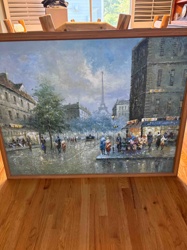
These notes were written by the person who submitted this item. Appraiser.AI has not verified them, and the AI's identification and estimate may rely on them.
AI Estimated Value
Not an official valuation
$400-600
AI estimate as of August 27, 2025 · verify with a professional before acting
AI-Generated · Verify before acting
Everything on this page is generated by AI for informational purposes only. AI can make mistakes — the AI may misidentify items or misattribute them (artist, maker, brand, designer, origin, era). This is not an official valuation and should not be used for insurance, sale, tax, estate, legal, or lending purposes — or any decision requiring a certified appraisal. It is not an authoritative claim about any person, brand, or rights holder — do not share or rely on it as a factual statement about a third party. Always consult qualified professionals before making financial decisions.
This analysis also relies on unverified notes provided by the user, which may be incomplete or inaccurate and could affect the result.
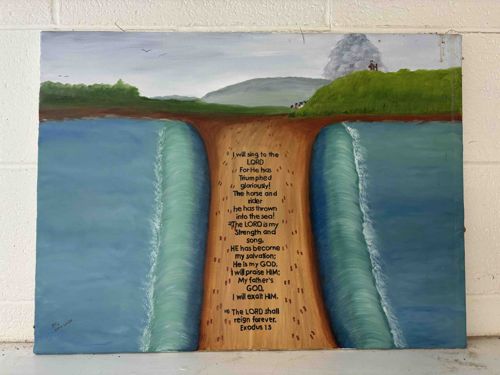
This is an acrylic painting on canvas, measuring 18 inches by 20 inches, created by artist Lorie Leahy. The artwork depicts a religious scene, presumably the parting of the Red Sea, with a central 'path' through the water. The composition is horizontally oriented. The main colors are blues and teals for the water, sandy browns for the exposed seabed, and greens for the distant landscape, topped by a light grey/blue sky. The water is rendered as two massive walls of liquid, with white frothy caps, suggesting dynamic movement and power. The central path is textured to resemble dry ground, with small dark specks that could represent footprints or debris. Above the path, a lengthy biblical verse from Exodus 15 is inscribed in black block letters, serving as a prominent textual element within the visual narrative. The distant horizon features rolling green hills or mounds, with a large, somewhat amorphous tree structure and what appears to be a small group of figures or animals. The overall style is illustrative and somewhat naive, with clear brushstrokes visible, typical of acrylics. The painting appears to be in good condition, showing no significant signs of wear, damage, or repairs, maintaining its vibrant colors. The artist's signature, "Lorie Leahy," is visible in the bottom left corner, indicating fine craftsmanship and origin. The estimated age is contemporary, likely from the late 20th or early 21st century, given the medium and subject matter often found in inspirational art.
AI Appraisal Report
Upon visual examination of "Parting of the Red Sea (Exodus 15)" by Lorie Leahy, an 18” x 20” acrylic on canvas, I find the condition to be remarkably good, appearing free from significant wear, damage, or repairs. The colors remain vibrant, consistent with a well-preserved acrylic painting. My assessment of authenticity is based on the visible signature, "Lorie Leahy," in the bottom left corner, which aligns with standard artistic practice for authentication through visual cues. However, it's crucial to note that this is a preliminary assessment. Full authentication would ideally require in-person examination to verify brushwork, paint application, and canvas characteristics, alongside provenance documentation (e.g., bills of sale, exhibition records) to trace its ownership history. For definitive certainty, especially if issues of forgery were suspected, scientific testing of pigments and materials might be employed.
In terms of market conditions, works by lesser-known contemporary artists, particularly those in the illustrative or inspirational art genre, tend to occupy a more accessible price point. While specific comparable sales for Lorie Leahy are not readily available, similar works by regional or emerging artists with comparable subject matter and medium typically fetch between $300 and $700 in gallery or secondary markets. The religious subject matter and inclusion of the biblical verse narrow the potential buyer demographic somewhat, focusing demand within those who appreciate Christian-themed art. While not exceedingly rare, the unique textual element and devotional nature give it a distinct identity. The illustrative style and legible brushwork do not suggest a highly formal academic training, which can limit appeal to certain collectors, but for its intended audience, it is well-executed. The size is also a marketable dimension for home display. Based on these factors, the painting represents a good value for collectors seeking evocative religious art.