AI Appraisal Estimate

AI-generated estimates · not official valuations

From the user

What was submitted

Photo and notes provided by the user — not generated by AI

Submitted item photo
Submitted photo · June 12, 2026

User's notes

No additional notes provided.

AI analysis below

AI appraisal

AI analysis & estimate

AI-Generated · Verify before acting

Everything below is generated by AI for informational purposes only. AI can make mistakes — the AI may misidentify items or misattribute them (artist, maker, brand, designer, origin, era). This is not an official valuation and should not be used for insurance, sale, tax, estate, legal, or lending purposes — or any decision requiring a certified appraisal. It is not an authoritative claim about any person, brand, or rights holder — do not share or rely on it as a factual statement about a third party. Always consult qualified professionals before making financial decisions.

Read the full disclaimer

AI Identification

·Not independently authenticated·Verify before acting

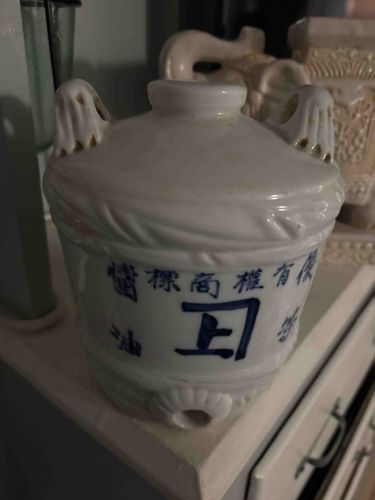
Vintage Blue and White Porcelain Chinese Soy Sauce Jar

Antiques & Collectibles - Asian Ceramics

AI Estimated Value

·Not an official valuation·Verify before acting

$45.00-$75.00

As of June 12, 2026

AI Item Analysis

·AI can make mistakes·Verify before acting
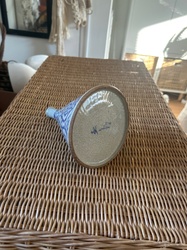
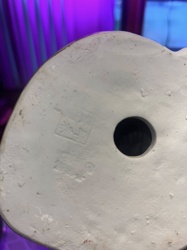
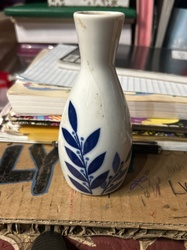
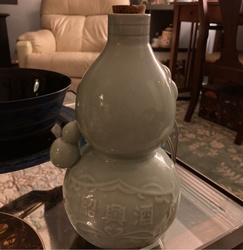
This item is a vintage Chinese porcelain lidded condiment jar, traditionally used for soy sauce or similar liquids. It features a tapered cylindrical body with molded rope-like texturing around the upper rim and base, simulating the appearance of a traditional woven basket or barrel. The piece is crafted from white porcelain and features underglaze cobalt blue hand-painted calligraphy and markings. The central character '上' (shang) is prominently displayed within a square border, often signifying 'superior' or 'high quality.' Flanking this are smaller inscriptions indicating 'Registered Trademark' and 'Soy Sauce.' The lid is dome-shaped with a central knob and two decorative loop handles styled like stylized feet or animals. The overall height is approximately 5 to 6 inches. Its condition appears fair to good for its age, with visible surface grime, minor pitting in the glaze, and some light brownish discoloration or patina near the top shoulder. There are no immediate large cracks visible, though tiny kiln firing flaws are present, which are characteristic of mass-produced mid-20th-century export ceramics. The craftsmanship reflects a utilitarian folk-art style rather than fine imperial porcelain, typical of the Republic period or early People's Republic of China era.
AI Appraisal Report

·AI can make mistakes·Verify before acting
I have examined the digital representation of this blue and white porcelain soy sauce crock. The piece exhibits characteristics consistent with mid-20th-century Chinese export utilitarian ware, likely dating between 1950 and 1970. The molded 'rope' texture and hand-painted cobalt 'shang' (Superior) mark indicate a standard production-line item intended for the domestic Chinese market or overseas diaspora regions. The condition appears fair; I note surface grime, glaze pitting, and iron-spotting (kiln grit) typical of folk-art kiln conditions. No major chips are visible on the body, though the lid fit and underside rim usually show wear in these examples. The market for this specific type of 'kitchen Qing' or early PRC utilitarian ware is stable but accessible. They are valued more as decorative 'shabby chic' accents or 'folk art' collectibles rather than investment-grade fine ceramics. Comparables sold at online auctions and regional antique malls typically fetch between $30 and $90 depending on the clarity of the calligraphy and the presence of the original lid. Critically, a visual examination via photograph cannot confirm the absence of hairline fractures or professional restorations. To fully authenticate the age and origin, I would require an in-person inspection of the unglazed foot rim to check for paste density and oxidation, as well as a 'ring test' for structural integrity. Provenance regarding its acquisition location (e.g., an old Chinatown grocery or a specific estate) would further solidify its historical context. This appraisal assumes the piece is made of standard hard-paste porcelain and is not a modern 21st-century distressed reproduction.

Get your items appraised

Instant estimates of your treasures with AI-powered appraisals

Browse More Appraisals