AI Appraisal Estimate

AI-generated estimates · not official valuations

From the user

What was submitted

Photo and notes provided by the user — not generated by AI

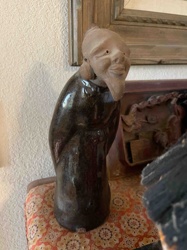
Submitted item photo
Submitted photo · June 4, 2026

User's notes

No additional notes provided.

AI analysis below

AI appraisal

AI analysis & estimate

AI-Generated · Verify before acting

Everything below is generated by AI for informational purposes only. AI can make mistakes — the AI may misidentify items or misattribute them (artist, maker, brand, designer, origin, era). This is not an official valuation and should not be used for insurance, sale, tax, estate, legal, or lending purposes — or any decision requiring a certified appraisal. It is not an authoritative claim about any person, brand, or rights holder — do not share or rely on it as a factual statement about a third party. Always consult qualified professionals before making financial decisions.

Read the full disclaimer

AI Identification

·Not independently authenticated·Verify before acting

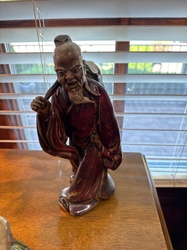
Chinese Porcelain Shoulao (God of Longevity) Figurine

Asian Antiques & Collectibles

AI Estimated Value

·Not an official valuation·Verify before acting

$400 - $600

As of June 4, 2026

AI Item Analysis

·AI can make mistakes·Verify before acting
This is a polychrome porcelain figurine representing Shoulao, the Chinese God of Longevity, often grouped as one of the Sanxing (Three Stars). Shoulao is depicted with his characteristic high, domed cranium, symbolizing wisdom and long life. He is dressed in an ornate robe featuring a vivid blue base with intricate floral or geometric motifs, possibly executed in the famille rose or a similar enamel style. In his right hand, he holds a dragon-headed wooden staff, and in his left, a peach of immortality. A small child figure (acolyte) is positioned at his side, reaching up toward the peach, which represents the blessing of offspring and continuity. The figure is mounted on a dark, rocky-style integrated base. Physically, the piece shows a glossy glazed finish with saturated color palettes typical of mid-20th-century decorative Chinese porcelain. The craftsmanship shows attention to detail in the flowing draped sleeves and the expressive, benevolent facial features. While no maker's mark is visible from this angle, its style is consistent with Republic period or late 20th-century export ware from centers like Jingdezhen. The condition appears fair, though there is some visible reflective glare that may mask fine surface crazing or age-appropriate wear to the gilding or enamel. The high forehead and beard are rendered in smooth, light-colored glazes contrasting with the textured robes.

AI Appraisal Report

·AI can make mistakes·Verify before acting
I have conducted a visual inspection of this polychrome porcelain figurine representing Shoulao, the Star God of Longevity. The piece displays the characteristic high cranium, dragon staff, and peach of immortality associated with this deity. Based on the saturated color palette, particularly the deep cobalt blues and the specific sheen of the glaze, this item appears to be a mid-to-late 20th-century export-quality piece, likely originating from Jingdezhen. While it captures the spirit of 'Republic Period' style, the uniform application of the enamels and the crispness of the molding suggest a more contemporary production date. The condition is generally good; the glaze retains a high gloss, and the acolyte figure remains intact, which is often a point of breakage. However, the market for late 20th-century Chinese decorative arts is currently saturated with similar export figures, which limits rarity and ceiling price. Comparables at auction for mid-sized export Shoulao figures typically range from $300 to $700 depending on the level of hand-painted detail and the presence of a maker's mark. Critically, this appraisal is based solely on digital images. A definitive valuation is limited by the inability to inspect the underside for firing cracks, ground-down foot rings, or period-correct marking stamps. To fully authenticate the age and provenance, a hands-on examination is required to check for 'orange peel' glaze texture or natural wear patterns on the base. I recommend physical inspection or original sales receipts to distinguish this from higher-value Republic-era (1912–1949) originals which can command significantly higher premiums.

Get your items appraised

Instant estimates of your treasures with AI-powered appraisals

Browse More Appraisals