AI estimate as of August 10, 2025 · verify with a professional before acting
AI-Generated · Verify before acting
Everything on this page is generated by AI for informational purposes only. AI can make mistakes — the AI may misidentify items or misattribute them (artist, maker, brand, designer, origin, era). This is not an official valuation and should not be used for insurance, sale, tax, estate, legal, or lending purposes — or any decision requiring a certified appraisal. It is not an authoritative claim about any person, brand, or rights holder — do not share or rely on it as a factual statement about a third party. Always consult qualified professionals before making financial decisions.
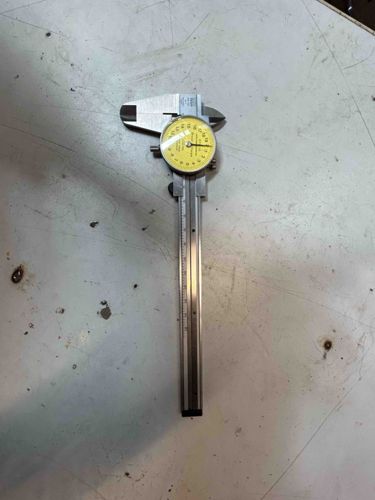
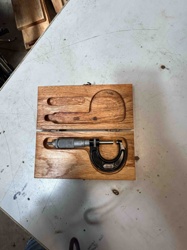
This is a dial caliper, a precision measuring instrument primarily constructed from polished metal, likely stainless steel or hardened tool steel, given its common use in manufacturing and machining. The instrument features a long, rigid main beam with clearly engraved imperial measurements along its length. A movable jaw slides along this beam, connected to a prominent, circular yellow dial indicator. The dial's face is bright yellow with black markings, including numerical increments from 0 to 10 in a clockwise direction, and a smaller set of numbers below, indicating '0.001"'. A single black needle indicates the precise measurement by showing rotations on the dial. The construction is robust, indicative of a tool designed for accuracy and durability. There are two sets of jaws: larger external jaws for measuring outside dimensions and smaller internal jaws for inside measurements. A depth rod is integrated for measuring depths, though its full extent is not visible. The surface shows minor signs of wear consistent with a used tool, such as light scratches and scuffs on the metal beam and jaws, which is typical for a tool of this nature and does not appear to impede its function. No specific maker's marks are clearly discernible from the image, but the quality of the finish and the clarity of the markings suggest a well-made, possibly industrial-grade, instrument. Its style is typical of dial calipers produced from the mid-20th century to the present day, emphasizing functionality and precision over ornate design. The bright yellow dial is a distinctive feature, aiding visibility.
AI Appraisal Report
I have examined the provided image of this dial caliper. The instrument presents as a robust, precision measuring tool, likely constructed from stainless steel or hardened tool steel, consistent with typical industrial-grade calipers. The bright yellow dial with clear black markings enhances readability. Condition-wise, it shows minor surface wear, including light scratches and scuffs on the metal beam and jaws, which is expected for a used tool of this type and suggests regular, rather than abusive, use. This wear does not appear to compromise its functionality. The presence of both external and internal jaws, along with an integrated depth rod, confirms its versatility.
From a market perspective, dial calipers are common and highly functional tools. The absence of discernible maker's marks limits specific brand valuation, but the overall quality appears to be good. Comparables in the used market for similar well-maintained, brand-agnostic industrial dial calipers typically range from \"good used condition\" to \"excellent condition.\" Demand for such tools remains steady among machinists, hobbyists, and in manufacturing settings.
Limitations for full authenticity and functionality assessment from an image alone are significant. I cannot verify the smooth operation of the slide, the accuracy of the dial indicator (i.e., if it returns to zero correctly and maintains calibration throughout its range), or the presence of any internal damage or excessive wear in the rack and pinion mechanism. Physical inspection would be crucial to confirm smooth action, precise calibration, and absence of excessive play. Provenance documentation, such as original purchase receipts or calibration certificates, if available, would enhance trust but are rarely present for such tools. Scientific testing is not typically applied to tools of this type for appraisal unless material composition is in question for a rare or vintage piece. This appraisal assumes the tool is in good working order despite the visible superficial wear.