AI estimate as of August 10, 2025 · verify with a professional before acting
AI-Generated · Verify before acting
Everything on this page is generated by AI for informational purposes only. AI can make mistakes — the AI may misidentify items or misattribute them (artist, maker, brand, designer, origin, era). This is not an official valuation and should not be used for insurance, sale, tax, estate, legal, or lending purposes — or any decision requiring a certified appraisal. It is not an authoritative claim about any person, brand, or rights holder — do not share or rely on it as a factual statement about a third party. Always consult qualified professionals before making financial decisions.
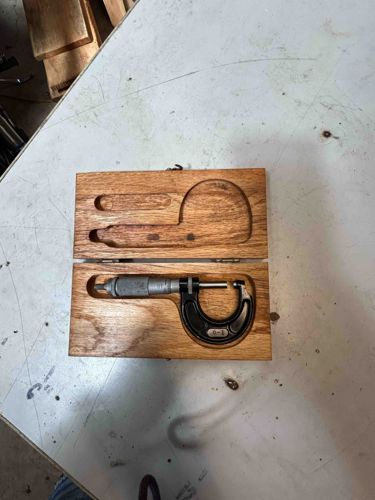
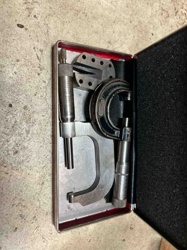
The item is a precision outside micrometer, housed within a fitted wooden case. The micrometer itself features a 'C'-shaped frame, primarily black in color, with a satin metallic thimble and spindle assembly. The frame appears to be made of cast metal, likely steel or iron, with a textured, possibly crinkle, finish that is generally well-preserved. There's a visible marking '0-1' on the black frame, indicating its measurement range, likely 0 to 1 inch. The spindle and thimble show some minor surface wear consistent with use, but no significant corrosion or pitting is immediately apparent. The visible parts suggest a robust construction, typical of precision measuring instruments designed for durability and accuracy. The wooden case, made of a light-colored hardwood exhibiting prominent grain patterns, is designed with a custom-routed recess perfectly shaped to cradle the micrometer. There are also two smaller, elongated recesses carved into the wood, likely intended for a calibration standard (gauge block or rod) and a spanner wrench, neither of which are present in the image. The wood itself shows some minor scuffs and marks on its surface, indicating handling over time, but generally appears solid with no visible cracks or serious damage. The case has a simple hinge mechanism, suggesting it opens fully to display its contents. This type of micrometer and case setup is indicative of a tool used in mechanical engineering, machining, or quality control, likely dating from the mid-20th century onwards given its general appearance and material choices. The craftsmanship of both the tool and the custom-fit case points to a focus on protecting and presenting a precision instrument.
AI Appraisal Report
I have examined the image of this outside micrometer in its wooden case. Based on the visual evidence, the micrometer appears to be in good overall condition. The 'C'-shaped frame shows a well-preserved black finish, and the satin metallic thimble and spindle assembly exhibit only minor surface wear, consistent with careful use, rather than abuse or neglect. No significant corrosion or pitting is visible, which speaks to proper storage and maintenance. The '0-1' marking clearly indicates its measurement range. The custom-fitted wooden case, made of a light-colored hardwood, is structurally sound with no apparent cracks, though some minor scuffs are present, indicating typical handling over time. The presence of recesses for a calibration standard and spanner wrench, which are currently absent, does slightly diminish its completeness. This type of precision instrument, likely dating from the mid-20th century onwards, is not exceedingly rare, but well-preserved examples like this one maintain a steady demand among machinists, collectors of vintage tools, and those who appreciate quality precision instruments. While I cannot definitively authenticate its precise age or manufacturer without physical inspection, the general construction aligns with known standards for such tools. Factors impacting value include the absence of accessories, but this is offset by the good condition of the micrometer itself and the custom-fit case. Without physical inspection, I cannot verify the micrometer's accuracy, the smoothness of its mechanism, or any internal wear. Full authentication of the manufacturer, and a more precise dating, would require examining any unreadable markings, checking serial numbers against manufacturer records, and a hands-on assessment of its mechanical integrity. Similarly, the wood type of the case could be confirmed with physical inspection.