These notes were written by the person who submitted this item. Appraiser.AI has not verified them, and the AI's identification and estimate may rely on them.
AI Estimated Value
Not an official valuation
$40-70
AI estimate as of November 25, 2025 · verify with a professional before acting
AI-Generated · Verify before acting
Everything on this page is generated by AI for informational purposes only. AI can make mistakes — the AI may misidentify items or misattribute them (artist, maker, brand, designer, origin, era). This is not an official valuation and should not be used for insurance, sale, tax, estate, legal, or lending purposes — or any decision requiring a certified appraisal. It is not an authoritative claim about any person, brand, or rights holder — do not share or rely on it as a factual statement about a third party. Always consult qualified professionals before making financial decisions.
This analysis also relies on unverified notes provided by the user, which may be incomplete or inaccurate and could affect the result.
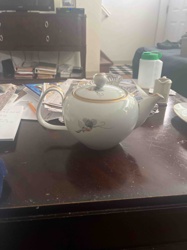
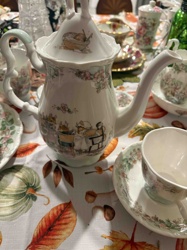
This is a ceramic teapot, likely earthenware or stoneware, featuring hand-painted decorations in the style of Alpine peasant ware. The body of the teapot is off-white or cream-colored with a slightly textured or speckled appearance, suggesting a rustic aesthetic. The dominant decorative motif on the main body is a delightful scene of a man and a woman dressed in traditional Bavarian or Alpine folk attire, holding hands and dancing. The man wears a blue jacket, brown shorts, green socks, and a green hat with a feather. The woman wears a blue top, a pink apron, a blue and white checkered skirt, and a blue hat. The figures are flanked by stylized floral and leafy designs in colors including yellow, pink, and various shades of green. A red-brown band encircles the rim of the teapot's body and the lid. The lid has a simple, integrated knob handle and also features the same red-brown band. The spout is adorned with a repetitive, muted red-brown pattern, possibly resembling a knitted texture or a decorative braid. The handle is a graceful C-shape, unadorned, and appears sturdy. The overall craftsmanship suggests a mass-produced item designed to evoke a folk-art aesthetic. There are no visible chips, cracks, or significant damage, and the painted decoration appears largely intact, indicating good preservation. Minor crazing or wear consistent with its age and use as a 'peasant ware' item might be present but is not clearly discernible from the image. Given the 'Alpine peasant ware' context and 'manufactured in Germany' hint, it likely dates from the mid-20th century, though without maker's marks, an exact age is difficult to ascertain. It is a charming example of decorative and functional ceramics from the region.
AI Appraisal Report
I have carefully examined the provided image of this German Alpine Peasant Ware Teapot with Dancing Figures. Visually, the teapot appears to be in very good condition, with no obvious chips, cracks, or significant paint loss. The colors remain vibrant. The style confirms it as traditional Alpine peasant ware, likely mass-produced in Germany, consistent with the owner's details. The design, featuring dancing figures and stylized florals, is charming and typical of this genre.
Market conditions for this type of decorative ceramic are generally stable but not highly collectible, falling into the category of folk art or quaint utilitarian ware. Comparable items, often found in online marketplaces or antique shops specializing in European country decor, typically range from $30 to $80. Factors impacting value positively include its good condition and endearing decorative motif. However, the mass-produced nature and absence of a specific maker's mark or rarity limit its upper value.
Demand for such items is moderate, primarily from collectors of specific regional folk art or individuals looking for decorative kitchenware. It is not considered particularly rare. Without the ability to physically inspect the piece, I cannot definitively assess minor crazing, exact material composition (earthenware vs. stoneware), or manufacturer's marks which would be crucial for precise dating and authentication. An in-person examination would allow me to check for invisible repairs, the exact texture and weight, and any subtle markings that might be obscured in photographs. Provenance documentation, such as original purchase receipts or family history, could also add to its historical context but is unlikely to significantly impact its monetary value given its type.