AI estimate as of November 12, 2025 · verify with a professional before acting
AI-Generated · Verify before acting
Everything on this page is generated by AI for informational purposes only. AI can make mistakes — the AI may misidentify items or misattribute them (artist, maker, brand, designer, origin, era). This is not an official valuation and should not be used for insurance, sale, tax, estate, legal, or lending purposes — or any decision requiring a certified appraisal. It is not an authoritative claim about any person, brand, or rights holder — do not share or rely on it as a factual statement about a third party. Always consult qualified professionals before making financial decisions.
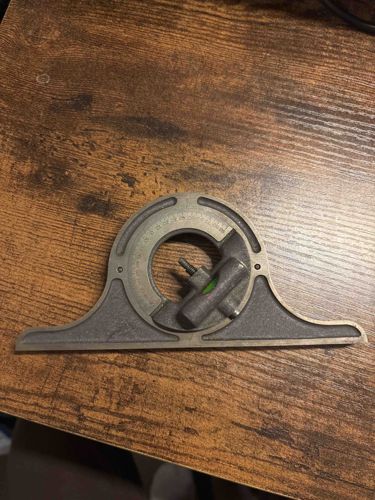
This item is a protractor head, a component of a combination square set, typically used in metalworking, woodworking, and machining for measuring angles and slopes. It features a robust construction, likely made from cast iron or steel, finished in a dark gray, textured paint or chemical blackening, with machined and polished silver-colored metal components for the protractor scale. The base is flat and elongated, forming a stable reference surface that is approximately 6-8 inches in length. At its center, a circular protractor scale is visible, graduated in degrees, with numerical markings that appear to range from 0 to 180, indicating its functionality for measuring angles. A pivoting arm or blade holder, also made of metal, is present, allowing for the attachment of a rule or blade (not present in the image). This arm is secured by a knurled locking screw, designed for adjusting and fixing the angle. Integrated into the pivoting mechanism is a small, green-tinted spirit level vial, indicating its dual purpose as a level for finding true horizontal or vertical planes. The overall condition appears used but well-maintained, showing some minor wear consistent with its utilitarian nature. No apparent significant damage, rust, or repairs are visible, suggesting good structural integrity. The craftsmanship appears to be industrial standard, focusing on precision and durability, characteristic of measuring tools from the mid to late 20th century to contemporary production.
AI Appraisal Report
I have carefully examined the provided image of the Combination Square Protractor Head. The item appears to be in good, used condition with minor wear consistent with its utilitarian purpose. The dark gray finish, machined components, and integrated spirit level suggest a robust, industrial-standard tool. From the image, there are no visible signs of significant damage, rust, or repairs, indicating good structural integrity. Functionally, the legible protractor scale and knurled locking screw seem to be in working order, though a hands-on test would be necessary to confirm accuracy.
Assessing authenticity solely from a photograph is limited. While the design is typical for measuring tools of this type, specific manufacturer markings (which are not visible) would be crucial for definitive authentication and dating. I cannot definitively ascertain the manufacturer or exact age without a physical inspection.
Market conditions for combination square protractor heads are generally stable. These are common and readily available tools, both new and in the secondary market. Comparables for a good quality, used protractor head from reputable brands (Starrett, Lufkin, Mitutoyo) typically range from $30 to $80, depending on condition and brand recognition. This item falls within that range. Demand is consistent among hobbyists and professionals. Rarity is low as these are mass-produced items.
Factors impacting value include the good visible condition, but also the lack of a known brand. For full authentication and to ascertain the exact condition for precise valuation, an in-person examination would be necessary to check for play in the pivot mechanism, the accuracy of the scale, the functionality of the locking screw, and to identify any manufacturer's marks. Without these, my appraisal is based purely on visual appearance and general market trends for comparable items.