AI estimate as of August 7, 2025 · verify with a professional before acting
AI-Generated · Verify before acting
Everything on this page is generated by AI for informational purposes only. AI can make mistakes — the AI may misidentify items or misattribute them (artist, maker, brand, designer, origin, era). This is not an official valuation and should not be used for insurance, sale, tax, estate, legal, or lending purposes — or any decision requiring a certified appraisal. It is not an authoritative claim about any person, brand, or rights holder — do not share or rely on it as a factual statement about a third party. Always consult qualified professionals before making financial decisions.
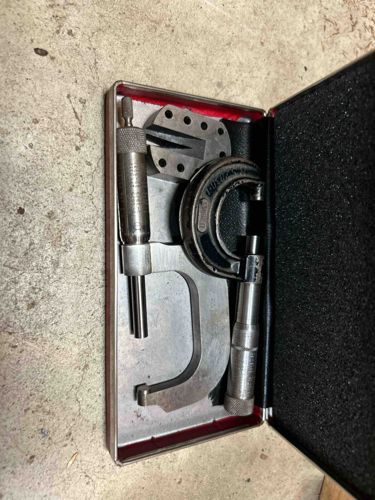
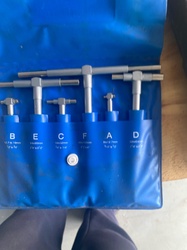
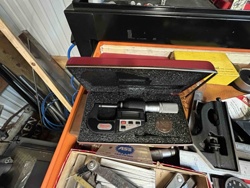
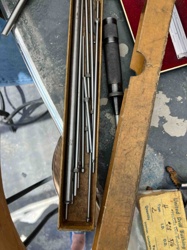
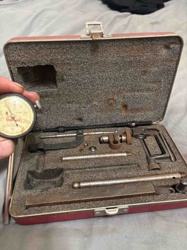
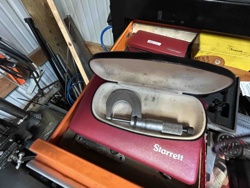
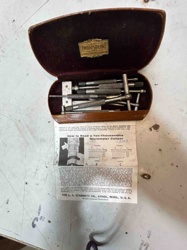
This is a vintage outside micrometer set, likely from the mid-20th century, presented in its original fitted case. The primary component is an outside micrometer, characterized by its "C" shaped frame, which appears to be made of black-painted cast iron or steel, showing some wear and chipping of the paint, revealing the metal underneath. The thimble and sleeve of the micrometer are silver-toned, likely chrome-plated or satin-chrome finished steel, with knurled sections for grip. The markings on the sleeve are partially visible, suggesting a measurement range. The set includes at least one interchangeable anvil or standard, designed to extend the measuring range of the micrometer, identifiable by its cylindrical shape and a knurled holding shaft. Another component appears to be an adjustment wrench or a special fixture, possibly for calibrating the micrometer, which is a flat, grey metallic piece with a central V-notch and multiple small holes around its perimeter. The interior of the case is lined with red velvet-like material on the bottom, which is stained and discolored, and black foam on the lid, indicating functional but aged padding. The case itself is a simple metallic box with a hinged lid, showing signs of external wear and possibly some minor tarnishing on the metal edges. The overall condition suggests that this tool has been used but maintained, with the wear consistent with a working instrument rather than a display piece. The craftsmanship appears to be industrial-grade, built for durability and precision.
AI Appraisal Report
Upon examining the provided image of this vintage outside micrometer set with its original case, I assess it to be a functional, albeit aged, precision tool. The 'C' frame micrometer shows typical wear on its black-painted finish, indicative of regular use rather than abuse. The silver-toned thimble and sleeve appear intact, with visible but worn markings. The presence of at least one interchangeable anvil suggests a multi-range set, enhancing its utility. The adjustment wrench is also a positive inclusion. The red velvet lining of the case is stained and the foam is aged, which is consistent with its probable mid-20th century origin. Authenticity, based solely on visual inspection, appears strong for an industrial-grade tool from that era; the design and construction align with standard vintage micrometer sets.
Market conditions for vintage precision tools are generally stable, driven by hobbyists, collectors, and those seeking durable, well-made older instruments. Comparables for similar vintage micrometer sets (e.g., Starrett, L.S. Starrett, Brown & Sharpe) in good working order typically range from $50 to $150, depending on the number of components and overall condition. Demand is moderate, not exceptionally rare, but a complete, functional set always holds more appeal. The primary factors impacting value here are the visible wear, especially the paint chipping and case deterioration, which detract slightly from collector appeal but do not necessarily impair function. The unknown exact measurement range and manufacturer (not clearly visible) also limit precise valuation.
Limitations for authentication from images alone are significant. I cannot verify the micrometer's accuracy or calibration, which is paramount for a measuring instrument. I also cannot assess internal wear or smooth operation. Physical inspection would allow me to check for binding, excessive play, the crispness of the markings, and the overall mechanical integrity. Provenance documentation (e.g., original purchase receipts, user manuals) would confirm its age and manufacturer, which cannot be definitively determined from the current image. Scientific testing is not typically required for these tools but a physical check of calibration standards would be necessary for a full functional appraisal. Without physical access, this appraisal remains an educated estimate based on visual cues.