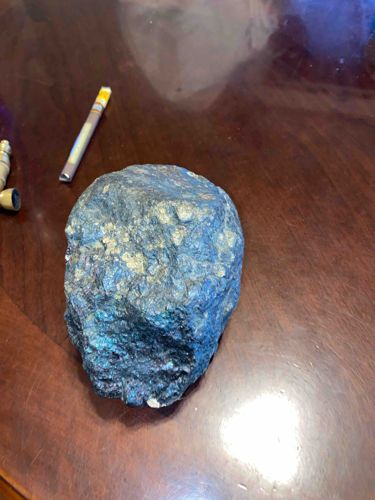
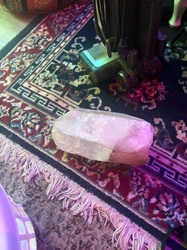
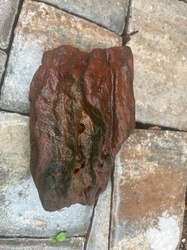
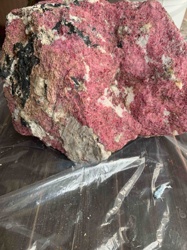
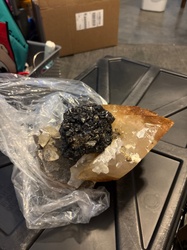
It’s a big heavy rock that has blue gold quartz rust
These notes were written by the person who submitted this item. Appraiser.AI has not verified them, and the AI's identification and estimate may rely on them.
AI Estimated Value
Not an official valuation
$50 - $150
AI estimate as of September 1, 2025 · verify with a professional before acting
AI-Generated · Verify before acting
Everything on this page is generated by AI for informational purposes only. AI can make mistakes — the AI may misidentify items or misattribute them (artist, maker, brand, designer, origin, era). This is not an official valuation and should not be used for insurance, sale, tax, estate, legal, or lending purposes — or any decision requiring a certified appraisal. It is not an authoritative claim about any person, brand, or rights holder — do not share or rely on it as a factual statement about a third party. Always consult qualified professionals before making financial decisions.
This analysis also relies on unverified notes provided by the user, which may be incomplete or inaccurate and could affect the result.
This item is a sizable mineral specimen, likely a rock or ore, characterized by its substantial size and weight, as indicated by the user's description. Its primary color is a deep, rich blue, which appears to be integral to the rock's composition rather than a surface coating. Interspersed within this blue matrix are numerous metallic or reflective inclusions. These inclusions exhibit a golden hue, suggesting the presence of gold or a gold-colored mineral such as pyrite (fool's gold). There are also patches of what appears to be rust or an iron oxide patina, introducing reddish-brown tones to the surface. The texture of the specimen is rough and irregular, with visible crystalline structures or concretion-like formations on its surface. While specific physical dimensions are not provided, its 'big' and 'heavy' nature implies a specimen of considerable geological interest. The varying colors and textures—blue, gold, and rust—create a visually complex and intriguing piece. No discernible manufacturing marks, signatures, or specific age indicators are visible. The specimen appears to be in its natural state, showing no signs of artificial cutting, polishing, or significant damage beyond expected natural weathering or geological processes. The craftsmanship, in this case, refers to the natural formation of the minerals, showcasing a unique combination of elements.
AI Appraisal Report
Based on my visual examination of the provided image and description, this is a substantial mineral specimen exhibiting a striking combination of blue, golden, and reddish-brown tones. The 'deep, rich blue' suggests minerals like Azurite or Covellite, while the 'golden hue' could be Pyrite or, less likely, native gold. The 'rust' patches indicate iron oxidation.
From a visual standpoint, the condition appears good for a natural specimen, with rough, irregular textures typical of geological formation. There's no indication of artificial alteration, which is positive for its natural integrity. Authenticity appears solid as a geological specimen, but the precise mineralogical composition cannot be definitively confirmed from images alone.
Market conditions for interesting, naturally occurring mineral specimens like this are generally stable, driven by collectors, interior decorators, and educational institutions. Comparables would include raw azurite or pyrite specimens of similar size and visual appeal. Demand exists for unique and colorful rocks, but rarity is challenging to assess without definitive identification. If the 'gold' is indeed native gold, the value would skyrocket, but usually, such specimens are much more overtly metallic and heavier than described for their size.
The primary limiting factor in this appraisal is the absolute identification of the minerals present, especially the blue and gold components. Without direct physical examination to assess hardness, streak, specific gravity, and, crucially, scientific testing (e.g., XRF analysis) to confirm mineral composition (especially to differentiate between gold and 'fool's gold' Pyrite), any valuation is speculative. Provenance documentation, while helpful for collector-grade pieces, is less critical for raw specimens unless tied to a famous mine or discovery. My valuation assumes common minerals with aesthetic appeal, as confirming precious metals or rare earths would require lab analysis.