AI estimate as of October 26, 2025 · verify with a professional before acting
AI-Generated · Verify before acting
Everything on this page is generated by AI for informational purposes only. AI can make mistakes — the AI may misidentify items or misattribute them (artist, maker, brand, designer, origin, era). This is not an official valuation and should not be used for insurance, sale, tax, estate, legal, or lending purposes — or any decision requiring a certified appraisal. It is not an authoritative claim about any person, brand, or rights holder — do not share or rely on it as a factual statement about a third party. Always consult qualified professionals before making financial decisions.
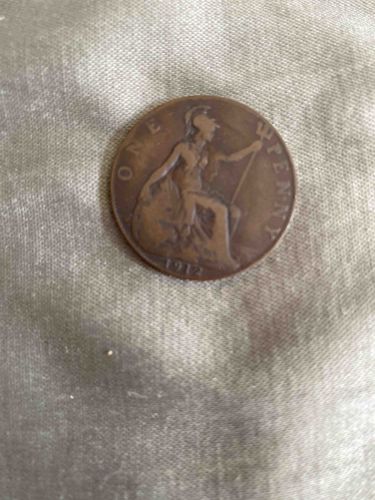
This item is a 1912 British One Penny coin, minted from bronze. It features the iconic image of Britannia seated on the reverse side. Britannia is depicted facing right, holding a trident in her left hand and a shield, bearing the Union Jack, in her right hand. The word "ONE" is visible to her left, and "PENNY" is to her right, encircling the upper edge of the coin. The date "1912" is clearly visible beneath Britannia. The coin exhibits a deep reddish-brown patina, consistent with aged bronze. There are noticeable signs of wear across the surface, particularly on the raised features of Britannia, indicating circulation. The edges appear somewhat softened, and there might be minor nicks or scratches, though precise details are difficult to ascertain from the provided image due to slight blurriness and resolution limits. Despite the wear, the primary details of the design and the date are legible. The overall condition suggests a 'Good' to 'Very Good' grade in numismatic terms, implying significant circulation but no severe damage. This coin represents the coinage of the reign of King George V, though his effigy (obverse) is not visible in this image. Its historical context places it within the early 20th century, a period of significant global changes.
AI Appraisal Report
Based on my visual examination of the provided image, I am appraising this 1912 British One Penny coin. The coin exhibits the expected design for its type, including Britannia seated on the reverse with 'ONE PENNY' and the date '1912' clearly visible. The reddish-brown patina is consistent with aged bronze. I note significant wear across the surface, particularly on the raised features, indicative of considerable circulation. The edges appear softened, and minor nicks or scratches are likely present, although the image resolution limits precise identification. Based on this visual assessment, I would grade the coin in the 'Good' to 'Very Good' range.
Authenticity, based solely on visual inspection, appears consistent with known examples of this coin. However, without physical examination, I cannot definitively confirm its authenticity. An in-person inspection would allow for weight, diameter, and thickness measurements, edge scrutiny, and detailed observation of die characteristics to confirm it is not a counterfeit or replica. Provenance documentation, though unlikely for such a common coin, would also aid in authentication. No scientific testing is typically required for this type of coin unless there are strong doubts about its metallic composition.
Market conditions for 1912 British One Penny coins in this circulated condition are generally low. These coins were minted in large quantities, making them very common. Demand is modest, primarily from novice collectors or for historical interest rather than high-end numismatic value. Rarities for this specific date and grade are non-existent. The primary factor impacting its value is its circulated condition. While it has historical appeal, its numismatic value is minimal due to its commonality and wear. Higher-grade examples, particularly uncirculated or proof, would command significantly higher prices. As such, I estimate its appraisal value to be between $0.50 and $2.00, reflecting its status as a common circulated specimen.