AI Appraisal Estimate

AI-generated estimates · not official valuations

From the user

What was submitted

Photo and notes provided by the user — not generated by AI

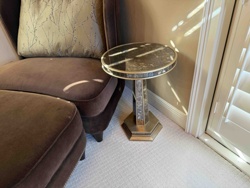
Submitted item photo
Submitted photo · June 9, 2026

User's notes

No additional notes provided.

AI analysis below

AI appraisal

AI analysis & estimate

AI-Generated · Verify before acting

Everything below is generated by AI for informational purposes only. AI can make mistakes — the AI may misidentify items or misattribute them (artist, maker, brand, designer, origin, era). This is not an official valuation and should not be used for insurance, sale, tax, estate, legal, or lending purposes — or any decision requiring a certified appraisal. It is not an authoritative claim about any person, brand, or rights holder — do not share or rely on it as a factual statement about a third party. Always consult qualified professionals before making financial decisions.

Read the full disclaimer

AI Identification

·Not independently authenticated·Verify before acting

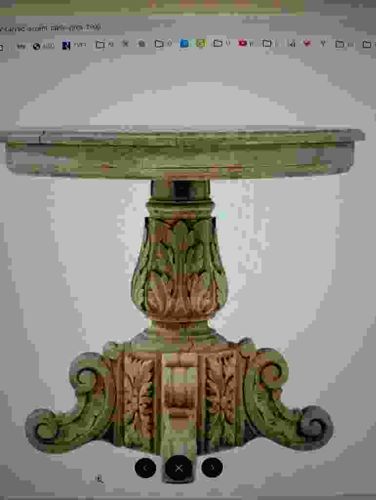
Italian Baroque Style Carved and Polychrome Pedestal Table

Furniture - Tables

AI Estimated Value

·Not an official valuation·Verify before acting

$1,800 - $2,500

As of June 9, 2026

AI Item Analysis

·AI can make mistakes·Verify before acting
This is a highly decorative pedestal side table, likely crafted in the Italian Baroque or Neoclassical revival style, dating from the late 19th to early 20th century. The piece features a circular top supported by a thick, heavily carved central baluster column that rests upon a tripartite architectural base. The most striking element is the distressed polychrome finish, showcasing a palette of sage green and terracotta red over a gesso-primed wood surface. The carvings are ornate, featuring large acanthus leaves on the central bulb and classical scroll motifs at the feet. Construction appears to be solid wood, possibly walnut or poplar, which was traditional for painted Italian furniture of this era. Regarding condition, there is significant and intentional distressing; visible wear includes extensive paint loss, chipping of the gesso layer, and surface abrasions that reveal the underlying wood and primer, creating a sought-after 'shabby chic' or 'grand tour' patina. The structural integrity of the base appears sound, though the heavily weathered surface suggests it may have been exposed to high humidity or was manufactured to mimic extreme antiquity. The quality of the hand-carved details indicates a skilled artisan, typical of Mediterranean decorative arts from the 1900s period.
AI Appraisal Report

·AI can make mistakes·Verify before acting
Based on my visual examination of this Italian Baroque revival pedestal table, I have assessed it as a fine example of late 19th-century European decorative arts. The piece exhibits high-quality hand-carving, particularly in the deep relief of the acanthus leaf central bulb and the robust tripartite base. The polychrome finish, featuring sage green and terracotta red, shows significant 'shabby chic' distressing. While some of the gesso loss and surface abrasions appear to be the result of natural age and environmental exposure, the pattern of wear suggests some intentional aesthetic enhancement to achieve a 'Grand Tour' antiquity look popular in the early 1900s. Current market conditions for Italian painted furniture remain steady, particularly for architectural pieces with significant scale. Comparable sales of similar 19th-century pedestals in weathered condition typically range between $1,500 and $3,000 at specialized antique auctions. The rarity of this piece is moderate, but its value is bolstered by the structural integrity of the heavy baluster and the desirable weathered patina which fits contemporary interior design trends. Note that this appraisal is based on photographic evidence alone. Identifying the specific wood species (likely walnut or poplar) and verifying the age of the pigments would require an in-person inspection. For a definitive authentication, I would recommend a microscopic analysis of the paint layers to distinguish between original 19th-century polychromy and later 20th-century 'distressing' techniques. Additionally, documentation of provenance or an examination of joinery techniques (such as hidden dowels or hand-cut threads) would be necessary to rule out a mid-20th-century reproduction.

Get your items appraised

Instant estimates of your treasures with AI-powered appraisals

Browse More Appraisals