AI identification & appraisal estimate

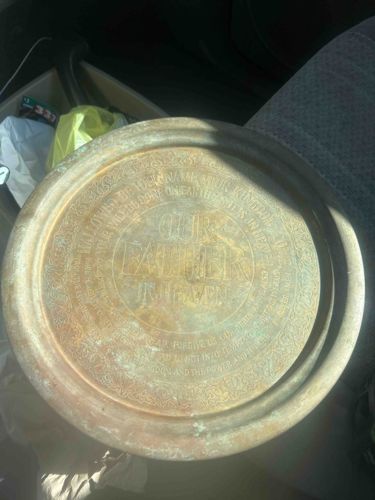
Skandar Ma & Sons Engraved Brass Lord's Prayer Wall Plaque

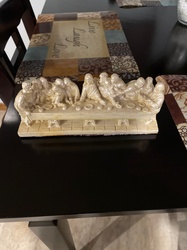
Submitted photo of Skandar Ma & Sons Engraved Brass Lord's Prayer Wall Plaque
Photo submitted by the user — not generated by AI

User's notes

SKANDAR MA &SONS NAZARE. Brass wall mount tray with the “Our Father In Heaven” pray in graved on it

These notes were written by the person who submitted this item. Appraiser.AI has not verified them, and the AI's identification and estimate may rely on them.

AI Estimated Value

Not an official valuation

$65.00 - $115.00

AI estimate as of December 20, 2025 · verify with a professional before acting

AI-Generated · Verify before acting

Everything on this page is generated by AI for informational purposes only. AI can make mistakes — the AI may misidentify items or misattribute them (artist, maker, brand, designer, origin, era). This is not an official valuation and should not be used for insurance, sale, tax, estate, legal, or lending purposes — or any decision requiring a certified appraisal. It is not an authoritative claim about any person, brand, or rights holder — do not share or rely on it as a factual statement about a third party. Always consult qualified professionals before making financial decisions.

This analysis also relies on unverified notes provided by the user, which may be incomplete or inaccurate and could affect the result.

Read the full disclaimer

AI Item Analysis

This circular brass wall plaque, manufactured by Skandar Ma & Sons in Nazareth, features a detailed engraving of 'The Lord's Prayer' (Our Father in Heaven). The item is constructed from a solid brass base, characterized by a dual-rimmed design that creates a recessed central field where the text and ornamentation are housed. The central logo 'OUR FATHER IN HEAVEN' is prominently displayed in large block lettering, surrounded by the complete text of the prayer in a circular layout. The perimeter is accented with an intricate, repeating vine-and-leaf filigree border, demonstrating significant craftsmanship in the metal-engraving process. In terms of condition, the piece shows a heavy, uneven patina consisting of oxidation and surface spotting, particularly visible in the lower-right and upper-left quadrants. There are signs of verdigris (greenish tarnish) in some of the deeper engraved areas, suggesting exposure to moisture over time. While the primary engraving remains legible, the overall surface finish has dulled from its original luster, typical of mid-20th-century religious brassware from the Holy Land. The back likely contains a hanger or mounting holes commensurate with its use as a wall-mounted decorative plate. Measuring approximately 10 to 12 inches in diameter, this piece serves as both a religious artifact and a souvenir of regional metalwork specialty.
AI Appraisal Report

I have carefully examined the provided images and descriptions of the Skandar Ma & Sons brass wall plaque. Authenticity is supported by the specific typographic style and the manufacturer's hallmark, consistent with mid-20th-century souvenir metalwork from Nazareth. The craftsmanship reflects the traditional sand-casting and hand-finishing techniques practiced in the region during the 1950s and 60s. The condition shows heavy oxidation and verdigris, which is common for these items but does negatively impact the value compared to pieces with a preserved lacquer or professional polish. The market for mid-century religious brassware remains stable, though these are relatively common souvenirs rather than unique liturgical artifacts. Comparables for Skandar Ma & Sons pieces of this size typically sell within the $60 to $120 range depending on the clarity of the engraving and the level of pitting. The value is driven primarily by its devotional appeal and its origin in the Holy Land. Limitations: This evaluation is based on photographic evidence only. In-person inspection is required to determine the depth of the oxidation and to ensure the metal is not prone to zinc pest or structural cracking. Provenance documentation, such as original purchase receipts or family records from the 20th century, would be necessary to establish a firm historical timeline. For full authentication of materials, a non-destructive X-ray fluorescence (XRF) test could be used to confirm the specific alloy composition of the brass.

Keep exploring

More religious decorative arts appraisals

Get your items appraised

Instant AI-powered appraisal estimates from a photo

Browse More Appraisals