AI estimate as of August 28, 2025 · verify with a professional before acting
AI-Generated · Verify before acting
Everything on this page is generated by AI for informational purposes only. AI can make mistakes — the AI may misidentify items or misattribute them (artist, maker, brand, designer, origin, era). This is not an official valuation and should not be used for insurance, sale, tax, estate, legal, or lending purposes — or any decision requiring a certified appraisal. It is not an authoritative claim about any person, brand, or rights holder — do not share or rely on it as a factual statement about a third party. Always consult qualified professionals before making financial decisions.
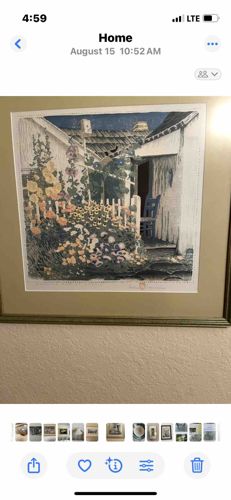
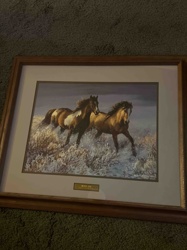
The item is a framed art print depicting a vibrant garden scene in front of a building, likely a cottage or house. The composition features a lush array of flowering plants, predominantly in shades of yellow, purple, and orange, bordering a light-colored picket fence. Behind the fence, a building with white walls and a dark, possibly thatched or tiled, roof is visible. An open doorway with a hint of blue inside suggests an interior space beyond. The artistic style appears to be a color woodcut or a similar printmaking technique, characterized by distinct lines and layered colors, giving it a somewhat textured appearance. The print is housed within a matting that appears light tan or off-white, and then enclosed in a simple, rectangular frame with a dark green or olive-colored finish. The frame itself has a slightly ornate, possibly reeded or molded, profile. While specific dimensions are not provided, based on the context of the image, it appears to be a medium-sized wall hanging. No visible damage or significant wear is apparent on the print itself from the provided image; however, the frame may show minor signs of age or handling consistent with a household item. The quality of the print appears good, with clear color registration. There are no discernible artist signatures or publisher marks visible in the provided image to ascertain manufacturing details or a precise age, but the style suggests a 20th-century origin, possibly mid to late. The framing and matting appear professional, indicating a certain level of care in its presentation.
AI Appraisal Report
Upon visual examination of the provided image, I assess this 'Garden Cottage Landscape Art Print' to be in good condition. The print's colors appear vibrant and well-registered, with no visible fading, tears, or significant blemishes. The matting seems clean, and the frame, while showing a slightly ornate profile, appears intact with no major damage readily apparent, though minor signs of age or handling are possible.
Authenticity: Based on the image, the print appears to be a legitimate art print, likely a color woodcut or similar technique given its characteristic lines and layered colors. However, without a physical examination, I cannot definitively confirm its authenticity as an original print versus a reproduction. In-person examination would allow for closer inspection of paper type, print impression, and potential watermarks or chop marks. The absence of a visible artist's signature or publisher's mark limits precise authentication and dating from the image alone. Provenance documentation, detailing the item's history of ownership, would be crucial for establishing a stronger claim of authenticity and potential rarity. Scientific testing, such as pigment analysis, could confirm the age and materials used.
Market Conditions & Comparables: The market for framed art prints, especially decorative landscape scenes, is generally steady. Similar mass-produced or decorative prints from the mid to late 20th century typically command modest prices. High-value comparables usually involve signed, limited-edition prints by known artists, or those with unique historical significance.
Demand & Rarity: Demand for generic decorative prints is moderate, driven primarily by aesthetic appeal and interior design needs rather than collectible value. This particular print does not appear to be rare based on visual cues; its style suggests it could be one of many produced in a similar vein. Rarity cannot be confirmed without artist identification and production details.
Factors Impacting Value: The primary value drivers for this item are its aesthetic appeal and good condition. The lack of an identifiable artist, edition number, or provenance significantly limits its value as a fine art collectible. If identified as a reproduction, its value would be considerably lower than an original print. Its likely decorative nature places it in a broad market segment with abundant supply.
Appraisal Limitations: As noted, full authentication and accurate dating are severely limited by examining images only. A hands-on inspection is essential to verify print type (original vs. reproduction), paper quality, and to search for hidden signatures or marks. Any assessment of value without physical inspection and provenance is provisional.