AI estimate as of September 9, 2025 · verify with a professional before acting
AI-Generated · Verify before acting
Everything on this page is generated by AI for informational purposes only. AI can make mistakes — the AI may misidentify items or misattribute them (artist, maker, brand, designer, origin, era). This is not an official valuation and should not be used for insurance, sale, tax, estate, legal, or lending purposes — or any decision requiring a certified appraisal. It is not an authoritative claim about any person, brand, or rights holder — do not share or rely on it as a factual statement about a third party. Always consult qualified professionals before making financial decisions.
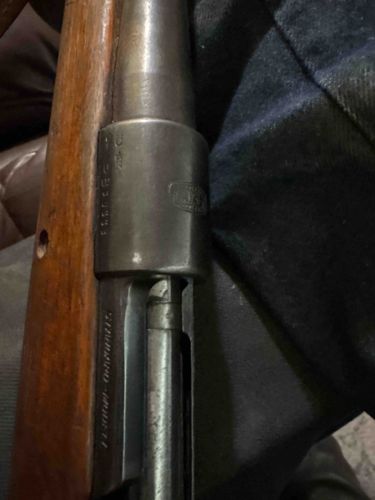
The item is a partial view of what appears to be the receiver and a section of the wooden stock of a Mauser K98k bolt-action rifle, or a very similar Mauser variant. The primary materials visible are blued steel for the receiver and barrel portion, and a light to medium brown wood for the stock. The blued finish on the steel shows considerable wear, visible as areas where the underlying gray metal is exposed, indicating significant use and handling. There is a discernible stamp on the receiver, located just above where the bolt would be, which appears to be a manufacturer's mark or acceptance stamp, possibly an eagle over a swastika, typical of Nazi Germany era production, consistent with the K98k. Below this, on the side of the receiver, there are vertical stampings that are difficult to fully decipher but look like serial numbers or model designations. The wood stock exhibits a relatively smooth finish with visible grain, suggesting a hard wood such as walnut or beech, commonly used for military rifle stocks. There are no obvious cracks or major gouges in the visible stock section, but typical wear and minor imperfections consistent with age and field use are present. The bolt itself is partially visible, appearing to be in a closed position, made of bright, unblued steel, which is common for Mauser bolts. The overall condition suggests a vintage firearm, likely dating from the mid-20th century, specifically the World War II era, given the probable markings. The craftsmanship appears robust and functional, as expected for a military-grade weapon designed for mass production and durability. The visible quality indicators point to a sturdy, well-engineered firearm, though its current state shows signs of authentic historical wear rather than pristine preservation.
AI Appraisal Report
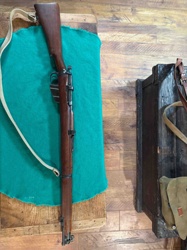
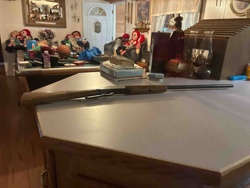
Based on my visual examination of this Mauser K98k carbine receiver and stock section, it is a genuine military firearm component, likely dating from the WWII era. The visible blued steel receiver shows significant wear, consistent with field use and age. The wooden stock, likely walnut or beech, also exhibits typical wear but no major damage. The partial view of the bolt appears correct for a K98k.
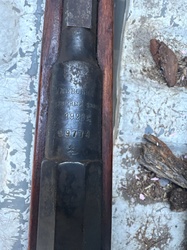
Key authenticating features include the apparent manufacturer's mark/acceptance stamp on the receiver (likely an eagle over a swastika, though partially obscured), and what appear to be serial or model stampings. This is consistent with what I'd expect from a German K98k of that period. However, without a clear view and in-person inspection, I cannot definitively confirm these markings, nor their originality. The unblued bolt is common for Mausers.
Market conditions for complete, intact Mauser K98k rifles are strong, particularly for those with clear, desirable markings and matching numbers. However, this item is a *section* – a receiver and stock, not a complete rifle. This significantly impacts its value. Such partial components are typically of interest to restorers needing parts, or to collectors for display purposes only if they are particularly rare variations or have exceptionally clear and historically significant markings.
Given its incomplete nature and evident wear, its rarity is limited to its potential as a specific donor part for a restoration. Demand is therefore much lower than for a complete rifle. Factors impacting value negatively are its incomplete state and the heavy finish wear. Positive factors are its potential authenticity as a genuine WWII-era German Mauser component.
My appraisal value of $100-200 reflects its status as a heavily used, incomplete receiver and stock section, suitable primarily for parts or a non-firing display. For full authentication and to confirm marking originality, an in-person examination by an expert, potentially including a full disassembly and close-up photography of all markings, would be necessary. Provenance documentation, if available, would also be invaluable. Without a complete rifle, chambering information, or the full serial number, its historical significance and precise model designation remain somewhat limited.