AI Appraisal Estimate

AI-generated estimates · not official valuations

From the user

What was submitted

Photo and notes provided by the user — not generated by AI

Submitted item photo
Submitted photo · June 6, 2026

User's notes

No additional notes provided.

AI analysis below

AI appraisal

AI analysis & estimate

AI-Generated · Verify before acting

Everything below is generated by AI for informational purposes only. AI can make mistakes — the AI may misidentify items or misattribute them (artist, maker, brand, designer, origin, era). This is not an official valuation and should not be used for insurance, sale, tax, estate, legal, or lending purposes — or any decision requiring a certified appraisal. It is not an authoritative claim about any person, brand, or rights holder — do not share or rely on it as a factual statement about a third party. Always consult qualified professionals before making financial decisions.

Read the full disclaimer

AI Identification

·Not independently authenticated·Verify before acting

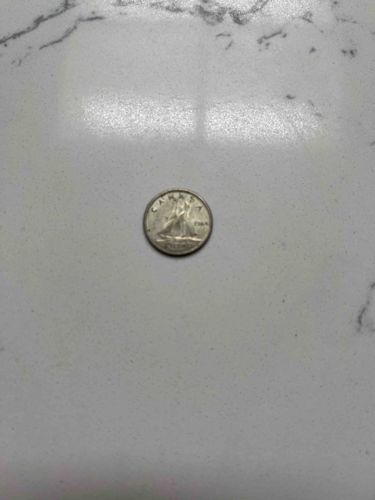
2004 Canadian 10-Cent Coin (Bluenose Dime)

Coin

AI Estimated Value

·Not an official valuation·Verify before acting

$0.10 - $0.25

As of June 6, 2026

AI Item Analysis

·AI can make mistakes·Verify before acting
The item is a circular metal coin, appearing to be made of a silver-toned alloy, likely copper-nickel or nickel, given its color and the era it seems to represent. The obverse is not visible, but the reverse clearly depicts an image of the Bluenose schooner, a famous Canadian fishing and racing vessel, sailing to the left. Above the schooner, the word "CANADA" is inscribed along the top rim, and below the schooner, the denomination "10 CENTS" is visible, with "2004" indicating the year of mintage positioned below the numeral '0' of '10'. The coin exhibits signs of moderate circulation, displaying some wear on the raised details of the schooner and the lettering, consistent with a coin that has been in everyday use. There are minor scratches and scuffs visible on the surface, and a slight darkening or toning in some of the recessed areas, which is typical patina for a coin of this age and material. The reeded edge is not clearly visible but is implied by the standard manufacturing of such coins. The overall condition suggests a 'Fine' to 'Very Fine' grade, with all major features still discernible but lacking original luster. The design, featuring the Bluenose, has been a consistent motif on Canadian dimes for many decades, indicating a classic Canadian coinage style. No significant damage like heavy dents or deep gouges is apparent, nor any signs of deliberate alteration or repair. The craftsmanship is standard for mass-produced currency, with clear, albeit somewhat worn, engraving.

AI Appraisal Report

·AI can make mistakes·Verify before acting
Upon my virtual examination of this 2004 Canadian 10-Cent Coin, it appears to be a genuine issue based on the consistent design elements of the Bluenose schooner, “CANADA,” “10 CENTS,” and the “2004” mintage year. The coin shows signs of moderate circulation, aligning with a 'Fine' to 'Very Fine' grade. Details on the schooner and lettering exhibit wear, and there are minor surface scuffs and typical toning. This condition is common for a coin of this age that has been in everyday use. In terms of market conditions, common circulating Canadian dimes from 2004 are abundant. There is no significant rarity associated with this particular mintage year. Demand for these common-date circulating dimes is generally limited to basic coin collecting, and they typically trade at very close to face value, or a slight premium. Factors significantly impacting value for such coins would include exceptional uncirculated condition (Mint State), key dates, or rare varieties; none of which are evident here. Limitations in authenticity verification exist solely through images. While the design appears correct, a full in-person examination would allow for precise measurements, weight verification, edge examination, and detailed surface inspection under magnification to confirm authenticity and rule out any sophisticated counterfeiting or alteration. Provenance documentation is not typically relevant for common circulating coins of this nature, and scientific testing is not generally required unless a rare variety or significant error is suspected.

Get your items appraised

Instant estimates of your treasures with AI-powered appraisals

Browse More Appraisals