AI Appraisal Estimate

AI-generated estimates · not official valuations

From the user

What was submitted

Photo and notes provided by the user — not generated by AI

Submitted item photo
Submitted photo · June 18, 2026

User's notes

No additional notes provided.

AI analysis below

AI appraisal

AI analysis & estimate

AI-Generated · Verify before acting

Everything below is generated by AI for informational purposes only. AI can make mistakes — the AI may misidentify items or misattribute them (artist, maker, brand, designer, origin, era). This is not an official valuation and should not be used for insurance, sale, tax, estate, legal, or lending purposes — or any decision requiring a certified appraisal. It is not an authoritative claim about any person, brand, or rights holder — do not share or rely on it as a factual statement about a third party. Always consult qualified professionals before making financial decisions.

Read the full disclaimer

AI Identification

·Not independently authenticated·Verify before acting

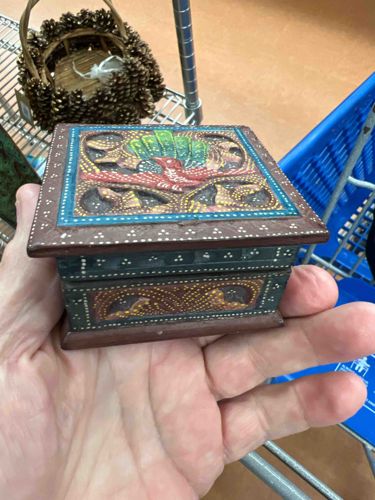
Hand-Carved and Hand-Painted Indian Folk Art Trinket Box

Decorative Arts / Folk Art

AI Estimated Value

·Not an official valuation·Verify before acting

$45 - $75

As of June 18, 2026

AI Item Analysis

·AI can make mistakes·Verify before acting
This is a small, rectangular decorative trinket box featuring intricate hand-carved openwork (jali) and vibrant hand-painted folk art. The lid displays a central stylized bird motif, likely a peacock or Phoenix, rendered in shades of red, green, and yellow against a dark recessed background. The borders are decorated with blue and white geometric patterns, including delicate white dot-work (pointillism style) that accents the edges and side panels. Constructed from a dark wood, likely sheesham or mango wood common in Indian crafts, the box measures approximately 3 to 4 inches in width. The sides feature secondary carvings highlighted with yellow and brown pigments. Structurally, the box shows a classic hinged lid design with a overhanging top and a slightly flared base. Regarding condition, there is visible chipping along the front edge of the lid and minor paint loss consistent with age and handling. The patina suggests a vintage origin, likely mid-to-late 20th century, originating from the Rajasthan or Uttar Pradesh regions of India known for wood carving excellence. The craftsmanship is expressive and artisanal rather than precision-machine made, giving it a unique, tactile quality characteristic of traditional regional handicrafts.
AI Appraisal Report

·AI can make mistakes·Verify before acting
I have examined the digital representation of this hand-carved and hand-painted Indian trinket box. The piece exhibits characteristics consistent with vintage folk art from the Rajasthan region, notably the jali (openwork) carving and the use of 'dot-work' or pointillism-style pigmentation. The construction utilizes sheesham wood, a dense hardwood native to the subcontinent, and shows honest wear including minor chipping and pigment loss on the lid, which attests to its age and utilitarian history. Market-wise, these items were abundant imports to the West during the late 20th century. While the artisan's hand is evident through the charmingly asymmetrical bird motif and the tactile quality of the carvings, the market is currently saturated with similar 'curio' items. Value is driven primarily by decorative appeal rather than rarity. Comparables for mid-tier Indian woodcrafts in this size range generally hammer between $30 and $90 at auction, depending on the intricacy of the jali work. Significant factors impacting value include the visible damage to the front edge, which prevents it from reaching 'mint' collectible status. However, the authenticity of the regional style remains a positive attribute. Limitations of this digital appraisal: I cannot verify wood density, the presence of modern synthetic lacquers versus traditional resins, or the smell—which is a key indicator of age in sheesham. A full authentication would require an in-person inspection to examine the hinge hardware for period-correctness and a microscopic examination of the pigments to rule out modern acrylics. Documentation of provenance, such as original import stamps or purchase receipts from the mid-20th century, would be necessary to certify its exact vintage.

Get your items appraised

Instant estimates of your treasures with AI-powered appraisals

Browse More Appraisals