AI estimate as of October 22, 2025 · verify with a professional before acting
AI-Generated · Verify before acting
Everything on this page is generated by AI for informational purposes only. AI can make mistakes — the AI may misidentify items or misattribute them (artist, maker, brand, designer, origin, era). This is not an official valuation and should not be used for insurance, sale, tax, estate, legal, or lending purposes — or any decision requiring a certified appraisal. It is not an authoritative claim about any person, brand, or rights holder — do not share or rely on it as a factual statement about a third party. Always consult qualified professionals before making financial decisions.
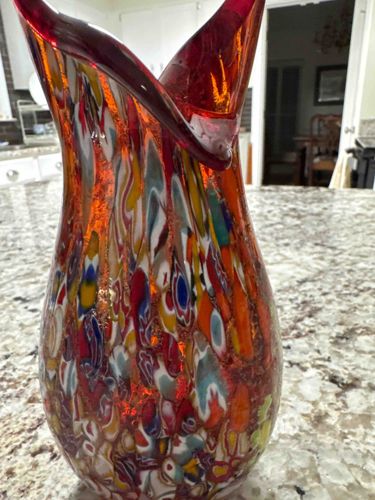
This exquisite item is identified as a Murano Millefiori Art Glass Vase with a fluted or ruffled rim. The vase is crafted from blown glass, featuring a vibrant and intricate 'millefiori' (Italian for 'thousand flowers') pattern throughout its body. The dominant color scheme is a rich red-orange, serving as the background for numerous distinct glass canes in a multitude of colors, including various shades of red, orange, yellow, blue, green, white, and black. These canes are intentionally arranged to create floral-like or abstract swirling designs within the glass. The form of the vase is an elongated ovoid, gently tapering towards a narrower base, and flaring out at the top to form a distinctive, undulating or fluted rim, which appears to be pulled upwards at two opposing points, creating a dynamic and organic silhouette. The glass itself exhibits a glossy finish and appears translucent, allowing light to interact with the embedded colored canes, producing a shimmering effect, particularly where the background glass is a richer orange. No visible cracks, chips, or significant damage are observable from the provided image; however, closer inspection would be required to ascertain its pristine condition. The quality of the millefiori work, with its tightly packed and well-defined patterns, suggests skilled craftsmanship. While no specific maker's marks or signatures are visible in the image, the style and technique are characteristic of Murano glass production, likely dating from the mid-20th century to contemporary times. The overall impression is one of high-quality decorative art glass.
AI Appraisal Report
This Murano Millefiori Art Glass Vase, with its unique fluted rim and distinctive coloration, presents as a charming and high-quality piece of decorative art. Upon visual examination of the provided image, the condition appears excellent, with no apparent chips, cracks, or significant damage. The millefiori canes are tightly packed and well-defined, indicating a skilled hand in its creation. The red-orange background, combined with the vibrant multi-colored canes, creates a striking visual effect, particularly with the translucent quality allowing light interaction. The elongated ovoid form and undulating rim contribute to its aesthetic appeal.
Market comparables for Murano millefiori vases of this quality, size, and vibrant color scheme generally fall within the $400-$600 range. Pieces by renowned Murano masters or those with specific maker's marks visible tend to command higher prices. Demand for authentic Murano art glass remains consistent, driven by collectors and interior designers appreciating its craftsmanship and beauty. While the piece is not exceptionally rare, good examples like this maintain a steady market presence.
Factors significantly impacting value include its presumed excellent condition and the attractive, well-executed millefiori pattern. The dynamic, ruffled rim also adds a desirable artistic element.
However, it's crucial to note the limitations of authenticating solely from images. Without a physical inspection, specific maker's marks or signatures cannot be confirmed. Authentication would benefit significantly from an in-person examination to assess the glass quality, pontil mark, and verify its origin. Provenance documentation, if available, would further strengthen attribution and value, but none was provided. Without these, while it strongly appears to be Murano, absolute certainty is not possible.