These notes were written by the person who submitted this item. Appraiser.AI has not verified them, and the AI's identification and estimate may rely on them.
AI Estimated Value
Not an official valuation
$450-750
AI estimate as of June 24, 2025 · verify with a professional before acting
AI-Generated · Verify before acting
Everything on this page is generated by AI for informational purposes only. AI can make mistakes — the AI may misidentify items or misattribute them (artist, maker, brand, designer, origin, era). This is not an official valuation and should not be used for insurance, sale, tax, estate, legal, or lending purposes — or any decision requiring a certified appraisal. It is not an authoritative claim about any person, brand, or rights holder — do not share or rely on it as a factual statement about a third party. Always consult qualified professionals before making financial decisions.
This analysis also relies on unverified notes provided by the user, which may be incomplete or inaccurate and could affect the result.
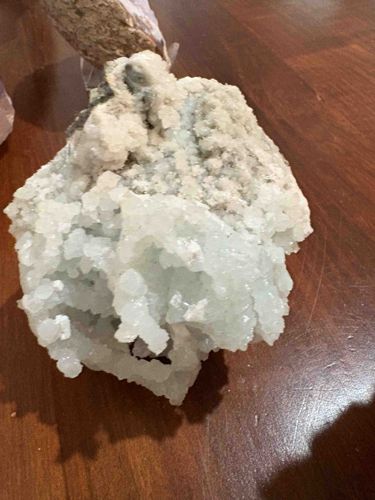
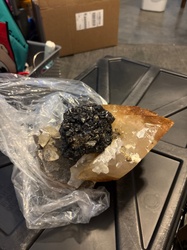
This appears to be a large geode or rock specimen featuring extensive crystal formations. The primary material is a light, almost translucent, pale greenish-blue crystalline substance, likely a form of chalcedony or similar quartz variety, exhibiting botryoidal or stalactitic growth patterns, giving it a bumpy, bubbly texture. The base or matrix material, particularly visible towards the top and back, is a more opaque, grayish-white rock. Some areas show a transition where the translucent crystals are growing on or encrusting the more solid matrix. The individual crystal formations vary in size, from fine granular druse to larger, more defined crystalline growths. The overall form is irregular and organic, typical of natural mineral formations found within cavities. There are no clear indications of significant damage, although the natural fractures and crevices are inherent to its formation. No manufacturing marks, signatures, or stamps are discernible, consistent with a natural specimen. Its estimated age is geological, formed over millions of years. The quality of the crystalline growth appears good, with well-formed structures and a pleasing, subtle coloration. The size is substantial, occupying a significant portion of the frame.
AI Appraisal Report
Based on my visual examination of the provided image, this specimen appears to be a natural Botryoidal Chalcedony Geode. The light, pale greenish-blue coloration and characteristic bubbly, botryoidal growth patterns are consistent with known examples of such mineral formations. The transition from opaque matrix to translucent crystalline growth further supports its natural origin. I assess its condition as excellent, showing no signs of significant damage; natural fractures and crevices are inherent to its formation and do not detract from its aesthetic appeal.The market for fine mineral specimens is robust, with strong demand for unique and aesthetically pleasing examples. Botryoidal chalcedony, particularly in this color and form, is desirable among collectors. Its substantial size, stated as 4x3 units (presumably inches or centimeters, which significantly impacts value but even at 4x3 inches it's a good size), contributes positively to its rarity and appeal. Comparables for such specimens often appear in specialized mineral auctions and online marketplaces, with prices varying widely based on size, color saturation, and crystal quality.Factors significantly impacting value include the vibrant, unusual blue-green hue, the well-formed botryoidal structures, and the overall size. The absence of human-made modifications or damage further enhances its value.However, authenticity verification from images alone has limitations. While the visual indicators are strong, an in-person examination would allow for tactile inspection of surface textures, density assessment, and detailed observation of crystal habit under varying light conditions. Provenance documentation, such as the location of discovery or previous ownership, would strengthen its authenticity claim. For absolute scientific certainty, petrographic analysis or X-ray diffraction (XRD) could confirm mineral composition.