These notes were written by the person who submitted this item. Appraiser.AI has not verified them, and the AI's identification and estimate may rely on them.
AI Estimated Value
Not an official valuation
$400-600
AI estimate as of November 18, 2025 · verify with a professional before acting
AI-Generated · Verify before acting
Everything on this page is generated by AI for informational purposes only. AI can make mistakes — the AI may misidentify items or misattribute them (artist, maker, brand, designer, origin, era). This is not an official valuation and should not be used for insurance, sale, tax, estate, legal, or lending purposes — or any decision requiring a certified appraisal. It is not an authoritative claim about any person, brand, or rights holder — do not share or rely on it as a factual statement about a third party. Always consult qualified professionals before making financial decisions.
This analysis also relies on unverified notes provided by the user, which may be incomplete or inaccurate and could affect the result.
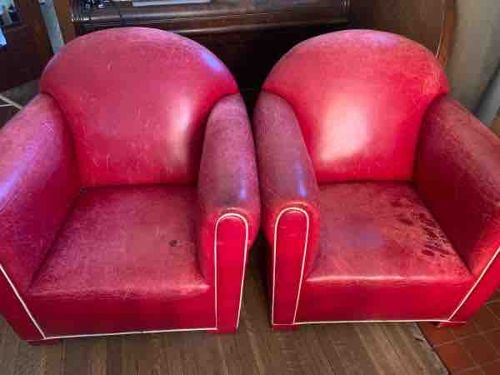
This is a pair of vintage tub chairs, upholstered in a vibrant red leather or faux leather material. Each chair features a distinctive rounded backrest that seamlessly flows into broad, rolled arms, creating a cozy and enveloping silhouette. The overall design suggests a comfortable, club-style aesthetic. A notable decorative element is the contrasting white piping that outlines the front edges of the arms and the base of the chairs, adding a crisp, tailored finish to the bold red upholstery. The construction appears sturdy, with a blocky, low-profile base that is fully upholstered down to the floor, concealing any legs.
Visible condition issues include significant wear and tear on the upholstery, particularly on the seating surfaces and the top of the armrests. The red material shows considerable cracking, fading, and discoloration, indicating extensive use and age. There are darker, possibly stained, areas on the top of the armrests, and areas where the finish has rubbed off, revealing a lighter base color or scuff marks. One chair's seat appears to have more concentrated areas of wear and possible staining. Despite the wear, the structural integrity of the chairs still seems present, though re-upholstery or extensive leather restoration would be required to return them to an optimal aesthetic condition. The style is reminiscent of Art Deco or mid-20th-century lounge furniture, possibly dating from the 1930s-1960s, though without specific maker's marks, a precise age is difficult to determine. The craftsmanship appears to be of a reasonable quality for its era, given the overall enduring form despite the surface wear.
AI Appraisal Report
I have examined the provided image of this pair of vintage red tub chairs. Visually, the design strongly suggests a mid-20th-century aesthetic, likely Art Deco to Mid-Century Modern (1930s-1960s). The rounded backrests and rolled arms provide a classic club chair silhouette. The contrasting white piping is a nice touch, adding a tailored element.
However, the condition is the primary factor impacting value. The red upholstery, whether leather or faux leather, shows significant wear, including cracking, fading, discoloration, and what appear to be scuffs and stains, particularly on the seating surfaces and armrests. These issues would necessitate professional re-upholstery or extensive restoration to bring them back to an optimal aesthetic, which can be a costly endeavor. Structurally, they appear sound, though this cannot be definitively confirmed without physical inspection.
Market demand exists for vintage lounge chairs, especially those with classic lines. However, the current condition places them in a category typically sold to those seeking a restoration project. Comparable vintage club chairs in excellent, original condition or professionally restored can fetch higher prices, often in excess of $1,500 for a pair. Given their current state, the value is primarily as a restoration candidate. Without specific maker's marks or provenance, attributing them to a renowned designer or manufacturer is impossible based on imagery alone.
To fully authenticate the material (real vs. faux leather) and confirm structural integrity, in-person examination would be crucial. Furthermore, any hidden maker's marks could significantly alter the valuation. My appraisal reflects their 'as-is' condition, acknowledging their vintage appeal but factoring in the substantial cost of restoration.