AI estimate as of November 10, 2025 · verify with a professional before acting
AI-Generated · Verify before acting
Everything on this page is generated by AI for informational purposes only. AI can make mistakes — the AI may misidentify items or misattribute them (artist, maker, brand, designer, origin, era). This is not an official valuation and should not be used for insurance, sale, tax, estate, legal, or lending purposes — or any decision requiring a certified appraisal. It is not an authoritative claim about any person, brand, or rights holder — do not share or rely on it as a factual statement about a third party. Always consult qualified professionals before making financial decisions.
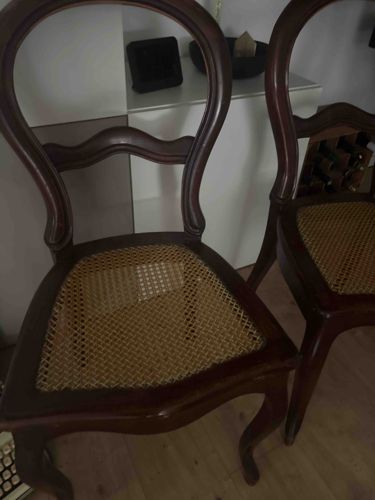
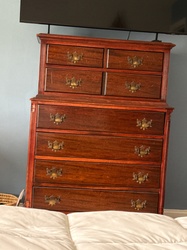
This image displays a pair of Bentwood style dining chairs, likely crafted from stained hardwood, exhibiting a rich, dark brown, possibly mahogany or walnut, finish. These chairs feature characteristic curved lines, typical of the Bentwood manufacturing technique which involves steaming and bending wood into elegant, organic forms. The backs of the chairs have a graceful, continuous curve forming the top rail and stiles, flowing downwards to meet the seat frame. Below the top rail, there is a subtle decorative wave-like carving or molding. The seats are constructed with woven cane, featuring a classic geometric pattern of small squares. This caning appears to be in good condition, showing no obvious breaks or sagging, suggesting robust construction or careful maintenance. The legs are slender and subtly curved, contributing to the overall lightweight and elegant aesthetic. The front legs appear to be cabriole-style, gently curving outwards. The finish shows some reflections, indicating a polished surface, and while no significant damage like cracks or deep scratches are immediately visible, a minor scuff or wear mark might be present on the top right chair's backrest. The chairs appear to be in a good, usable condition, consistent with pieces from the late 19th to mid-20th century, a period when Bentwood furniture was highly popular. The craftsmanship, characterized by smooth curves and precise joinery, suggests a well-made, quality product designed for both aesthetics and durability.
AI Appraisal Report
Based on my visual examination of the provided image, this pair of Bentwood caned dining chairs appears to be in good overall condition, displaying characteristic late 19th to mid-20th-century craftsmanship. The rich, dark brown finish, likely mahogany or walnut, shows a polished surface with minor wear, such as a possible scuff on one backrest, but no significant damage like cracks or major chipping is evident. The cane seats appear intact and well-maintained. The bentwood styling, with its elegant curves and slender legs, is consistent with period manufacturing.
Authenticity, while suggested by the visual cues, cannot be definitively confirmed without physical inspection. The precise origin (e.g., Thonet or a contemporary manufacturer) and specific wood type would require in-person examination, including potential maker's marks, joinery analysis, and wood grain inspection.
In terms of market conditions, Bentwood chairs are a classic and generally hold steady appeal. While they are not exceptionally rare, a well-preserved pair like this will attract buyers seeking vintage charm and functional seating. Demand is moderate, particularly for pieces that don't require immediate restoration. The lack of distinct provenance or a renowned maker's mark limits the top-end value. Without documentation or a physical inspection to verify authenticity, maker, and exact age, my valuation is based purely on visual condition and general market comparables for unmarked bentwood dining chairs. Factors impacting value positively are the apparent good condition of the caning and wood; negatively, the inability to verify the maker or precise age through images alone.
For full authentication and a more precise valuation, I would require an in-person examination to inspect for maker's marks, assess the joinery, verify wood type, confirm the chairs' age, and conduct a thorough condition report. Provenance documentation, if available, would also be crucial.