AI Appraisal Estimate

AI-generated estimates · not official valuations

From the user

What was submitted

Photo and notes provided by the user — not generated by AI

Submitted item photo
Submitted photo · June 16, 2026

User's notes

No additional notes provided.

AI analysis below

AI appraisal

AI analysis & estimate

AI-Generated · Verify before acting

Everything below is generated by AI for informational purposes only. AI can make mistakes — the AI may misidentify items or misattribute them (artist, maker, brand, designer, origin, era). This is not an official valuation and should not be used for insurance, sale, tax, estate, legal, or lending purposes — or any decision requiring a certified appraisal. It is not an authoritative claim about any person, brand, or rights holder — do not share or rely on it as a factual statement about a third party. Always consult qualified professionals before making financial decisions.

Read the full disclaimer

AI Identification

·Not independently authenticated·Verify before acting

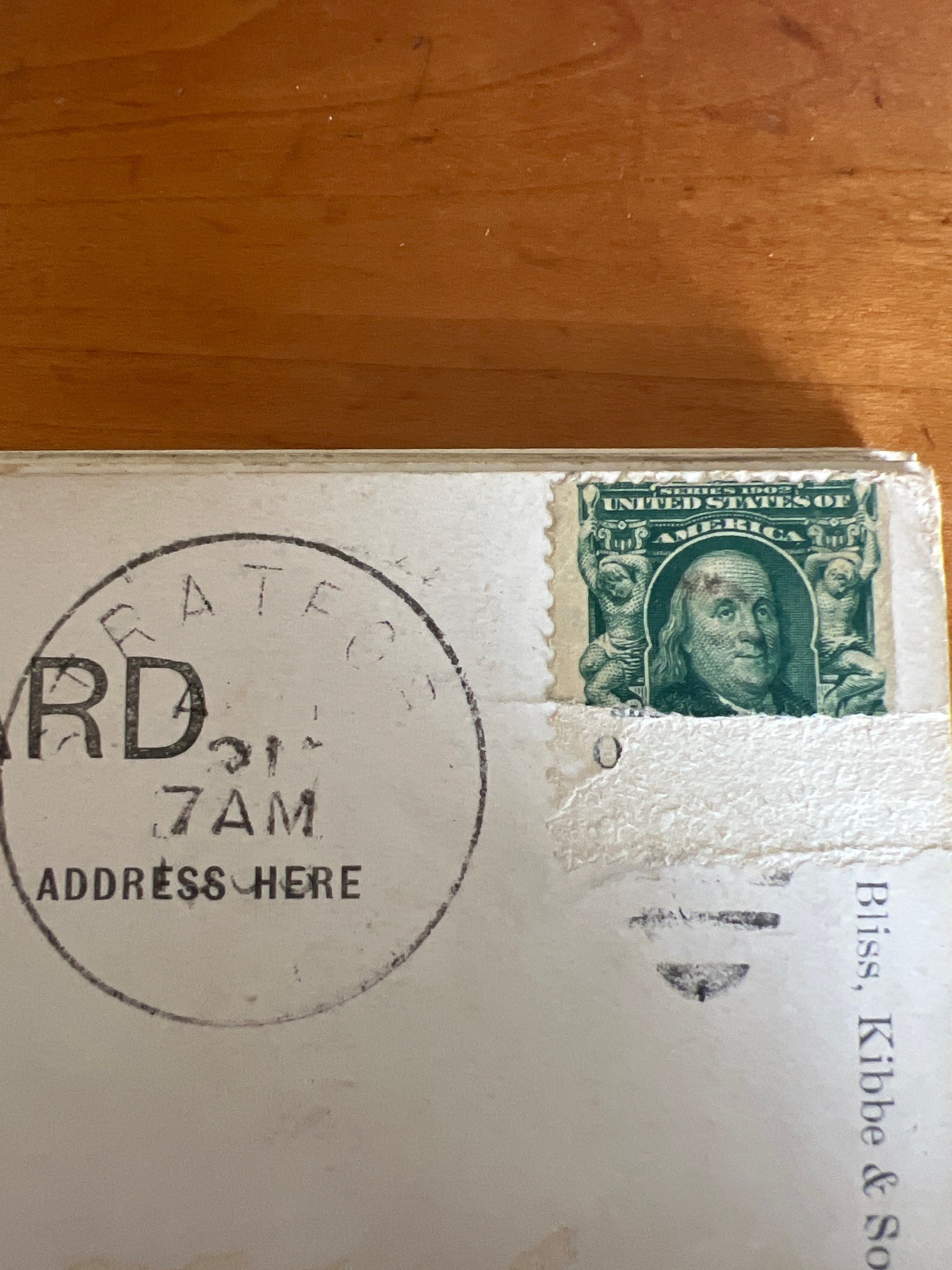
1902 Series 1-Cent Benjamin Franklin Postage Stamp on Postcard

Philately / Collectibles

AI Estimated Value

·Not an official valuation·Verify before acting

$1.00 - $3.00

As of June 16, 2026

AI Item Analysis

·AI can make mistakes·Verify before acting
This is a United States 1-cent postage stamp from the 'Series of 1902' featuring the portrait of Benjamin Franklin. The stamp is printed in a blue-green or dark green ink on white paper, featuring a classic Beaux-Arts design with two supporting figures (caryatids) flanking the central portrait frame. The text 'SERIES 1902' is visible at the very top, with 'UNITED STATES OF AMERICA' below it. The stamp is affixed to what appears to be a vintage postcard. Notable markings include a partial circular date stamp (CDS) from 'STRATFORD' with a '7 AM' time indicator and part of a 'RD' designation, likely from a postcard address field. Regarding condition, the stamp shows a small reddish-brown mark on Franklin's forehead, which could be a stray ink mark or minor staining. The surrounding postcard is significantly damaged; there is a large, jagged horizontal tear directly below the stamp where paper has been stripped away, and the right edge of the card is heavily frayed. The cancel mark is somewhat faded and incomplete. The printing of the stamp itself appears crisp, characteristic of the Bureau of Engraving and Printing's high-quality line-engraved work during the early 20th century. The item represents a common but historically significant era of American philately, specifically the transition into the golden age of postcards.

AI Appraisal Report

·AI can make mistakes·Verify before acting
I have conducted a visual examination of this United States 1-cent Benjamin Franklin stamp (Scott #300) from the Series of 1902. The stamp exhibits the crisp, high-quality engraving typical of the Bureau of Engraving and Printing's output during this era. While the central portrait remains clear, several condition issues significantly impact its secondary market value. I observed a reddish-brown stain on Franklin’s forehead and a partial, somewhat faded Stratford cancellation. Most critically, the underlying postcard substrate has suffered severe structural failure, including a large horizontal tear and edge fraying that compromises the item's integrity as a complete postal history piece. The Series of 1902 was produced in massive quantities—over 11 billion units—making this a very common issue. High-value examples typically require 'gem' centering or rare specialized perforations, neither of which are present here. Current market demand for damaged common-issue stamps on torn cards is negligible, as collectors prioritize pristine condition or rare postal markings. My valuation reflects its status as a common historical curiosity rather than a high-grade investment piece. This appraisal is based solely on digital imagery. A physical inspection is required to check for hidden thins, repairs, or to verify the exact watermark and perforation measurements (12 gauge). Authenticity appears consistent with the period, but scientific forensic testing of the ink and paper, along with provenance documentation, would be necessary for a definitive certification. Without such verification, this assessment remains a preliminary estimate for insurance or informational purposes.

Get your items appraised

Instant estimates of your treasures with AI-powered appraisals

Browse More Appraisals