AI estimate as of November 11, 2025 · verify with a professional before acting
AI-Generated · Verify before acting
Everything on this page is generated by AI for informational purposes only. AI can make mistakes — the AI may misidentify items or misattribute them (artist, maker, brand, designer, origin, era). This is not an official valuation and should not be used for insurance, sale, tax, estate, legal, or lending purposes — or any decision requiring a certified appraisal. It is not an authoritative claim about any person, brand, or rights holder — do not share or rely on it as a factual statement about a third party. Always consult qualified professionals before making financial decisions.
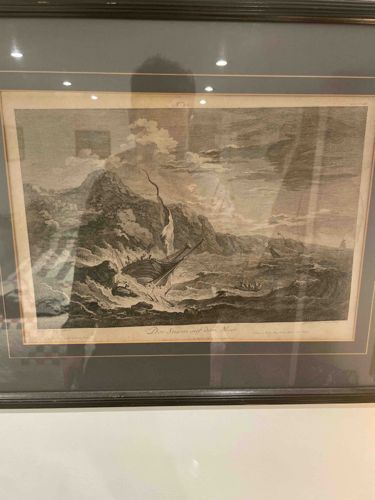
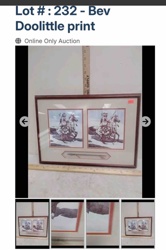
This item is a framed engraving titled "Der Sturm auf dem Meer," which translates to "The Storm at Sea." The scene depicted is a dramatic maritime landscape featuring a ship in distress amidst tumultuous waves, close to a rugged, rocky coastline. The ship appears to be foundering, possibly shipwrecked, with its mast broken and sails ripped. A group of figures can be seen in the water or clinging to debris, highlighting the peril of the situation. The background shows a chaotic sky with dark clouds, emphasizing the intensity of the storm. The engraving is executed in a monochromatic palette, likely black ink on off-white paper, typical of its medium. The details are finely etched, showcasing the artist's skill in rendering the rough textures of the sea, the jagged rocks, and the distressed vessel. The print is housed in a dark, possibly wooden, frame with a simple, yet elegant profile. The frame appears to have some minor scuffing or wear commensurate with age. The print is matted, likely with an off-white or cream-colored mat, which is protected by a sheet of glass or acrylic. Reflections on the glass make it difficult to ascertain the exact condition of the print itself, though no significant tears or creases are immediately apparent. The textual inscription at the bottom center of the print, "Der Sturm auf dem Meer," is clearly visible, with additional, smaller text to its right, which is harder to decipher but likely includes the artist's or engraver's name and possibly the publisher or date. The style suggests a period piece, possibly 18th or 19th century, given the subject matter and engraving technique. The craftsmanship of the engraving appears high, with good tonal variation and intricate line work.
AI Appraisal Report
This framed engraving, 'Der Sturm auf dem Meer,' is a dramatic maritime scene. Visually, the print appears to be in good condition, with no overt tears or significant creasing observed through the glass. The engraving's fine detail and tonal variations suggest skilled craftsmanship, likely from the 18th or 19th century, aligning with its thematic and stylistic elements. The frame shows minor wear, consistent with its age, and the matting appears intact.
Market-wise, engravings of this era depicting maritime scenes of distress generally attract a moderate collector base. Comparable works by recognized engravers can fetch higher prices, but unsigned or less documented pieces tend to be in the more accessible range. The demand exists, but it is not for exceptionally rare items unless linked to a prominent artist or historical event. The value is primarily driven by its aesthetic appeal, condition, and perceived age.
My primary limitation in determining authenticity and condition is the reliance on images alone. I can't definitively confirm the paper quality, detect foxing or discoloration beneath the mat, or assess the full integrity of the print without physical inspection. Also, verifying the printer, artist, or specific publication details without being able to thoroughly examine any textual inscriptions or perform an in-hand comparison with known examples is difficult. To fully authenticate and ascertain value, an in-person examination to check for watermarks, paper type, and artist's signatures, along with provenance documentation, would be ideal.