AI Appraisal Estimate

AI-generated estimates · not official valuations

From the user

What was submitted

Photo and notes provided by the user — not generated by AI

Submitted item photo
Submitted photo · June 16, 2026

User's notes

No additional notes provided.

AI analysis below

AI appraisal

AI analysis & estimate

AI-Generated · Verify before acting

Everything below is generated by AI for informational purposes only. AI can make mistakes — the AI may misidentify items or misattribute them (artist, maker, brand, designer, origin, era). This is not an official valuation and should not be used for insurance, sale, tax, estate, legal, or lending purposes — or any decision requiring a certified appraisal. It is not an authoritative claim about any person, brand, or rights holder — do not share or rely on it as a factual statement about a third party. Always consult qualified professionals before making financial decisions.

Read the full disclaimer

AI Identification

·Not independently authenticated·Verify before acting

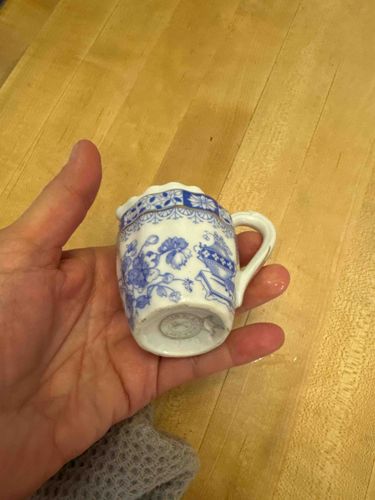
Miniature Blue and White Ceramic Creamer

Antique Ceramics and Miniature Collectibles

AI Estimated Value

·Not an official valuation·Verify before acting

$15.00 - $35.00

As of June 16, 2026

AI Item Analysis

·AI can make mistakes·Verify before acting
This item is a miniature ceramic creamer or pitcher, constructed from white earthenware or ironstone with a transfer-printed cobalt blue decoration. The piece measures approximately 2 to 2.5 inches in height, fitting easily within the palm of a hand. Its design features a scalloped rim and a vertically faceted or fluted body, complemented by a simple C-scroll handle. The decoration consists of a classic floral and urn motif, evocative of traditional English Chinoiserie or 'Dutch' styles common in 19th and early 20th-century pottery. A decorative geometric border encircles the interior and exterior of the rim. Notably, there is a visible maker's mark on the underside of the base, appearing as a circular green or blue stamp, which likely identifies it as an early 20th-century souvenir or toy tea set piece, possibly of Dutch (Delft-style) or German origin. In terms of condition, the piece shows significant evidence of age and use, including a prominent vertical crack or crazing line near the handle and visible chipping or loss of glaze around the foot rim and body. The transfer print is slightly blurred in areas, typical of mass-produced utilitarian ceramics of the period. The presence of surface grime and minor staining suggests a long period of display or storage without specialized care.
AI Appraisal Report

·AI can make mistakes·Verify before acting
I have examined the digital representation of this miniature blue and white ceramic creamer. The item, roughly 2.5 inches in height, appears to be an early 20th-century toy or souvenir piece. The transfer-printed cobalt decoration on a faceted white body suggests a mass-market production intended to mimic more expensive Delftware or English Flow Blue. My assessment of the condition reveals significant liabilities: a prominent vertical crack near the handle and noticeable chipping along the foot rim. These structural defects, alongside the inherent 'blurring' of the transfer print, severely limit its desirability among high-end collectors. The market for miniature ceramics is currently stable but favors pristine examples from prestigious manufacturers like Minton or Royal Worcester. As a likely souvenir piece of Dutch or German origin, its value is primarily decorative or sentimental. Comparable pieces in excellent condition typically sell for $40-$60; however, the visible damage to this specific item necessitates a downward adjustment to the current valuation. Note that this appraisal is based strictly on visual evidence from the provided image. My assessment of the earthenware body and glaze cannot be definitive without a physical 'ring test' to determine the extent of internal fractures. Furthermore, while the underside mark provides a period-correct indicator, a professional in-person inspection of the glaze's chemical composition and the pigment's application under magnification would be required for absolute verification of age. To achieve full authentication, documented provenance or a catalog reference for the specific maker's mark would be necessary.

Get your items appraised

Instant estimates of your treasures with AI-powered appraisals

Browse More Appraisals