AI estimate as of September 25, 2025 · verify with a professional before acting
AI-Generated · Verify before acting
Everything on this page is generated by AI for informational purposes only. AI can make mistakes — the AI may misidentify items or misattribute them (artist, maker, brand, designer, origin, era). This is not an official valuation and should not be used for insurance, sale, tax, estate, legal, or lending purposes — or any decision requiring a certified appraisal. It is not an authoritative claim about any person, brand, or rights holder — do not share or rely on it as a factual statement about a third party. Always consult qualified professionals before making financial decisions.
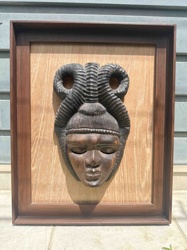
This item is a framed bas-relief wall art piece, likely a reproduction, depicting a scene in the ancient Neo-Assyrian style. The central figure is a winged deity or protective spirit, characterized by elaborate headwear, a highly stylized beard and hair, and detailed garments. The figure holds a branching leaf or palm frond in one upraised hand and cradles a goat or ibex in the other arm, with the animal's legs dangling down. The relief is executed in a light brown or tan material, possibly a cast resin, plaster, or a composition material, designed to mimic ancient stone or clay tablets. The background is slightly uneven, suggesting a hand-finished look or an attempt to simulate aged rock. The texture of the relief shows fine lines and patterns, particularly on the deity's clothing, wings, and beard, indicating a good level of detail in its creation. The piece is set within a dark stained, possibly wooden, frame that has a simple but elegant profile. The frame appears to be in good condition with minor wear consistent with display, such as slight scuffs on the edges, but no significant damage is visible. The overall aesthetic is one of historical recreation, aiming to evoke the grandeur and monumental artistry of Mesopotamian civilization. Given the sharp details and consistent coloration, it is likely a modern decorative piece rather than an ancient artifact, created for aesthetic appeal and historical reference. The quality of the casting and the crispness of the details suggest careful manufacturing. There are no obvious repairs or significant condition issues; the patina appears uniform, suggesting it is either intentional or the material's natural aged appearance.
AI Appraisal Report
Based on my visual examination of the provided image, this Assyrian-style bas-relief wall art piece is a decorative reproduction. The casting quality is good, with crisp details on the deity's elaborate headwear, beard, and garments, and the texture appears uniform. The overall condition of the relief and its dark-stained frame is excellent, showing only minor scuffs consistent with display. There are no visible repairs or significant damage, and the patina is consistent with an intentionally aged or modern finish.
This piece is clearly a modern decorative item, not an ancient artifact. The consistent coloration, sharp details, and material (likely resin, plaster, or a composition material) suggest contemporary manufacture designed to evoke the Neo-Assyrian aesthetic rather than being an archaeological find. The market for such reproductions is robust, driven by interest in ancient history and unique home decor. Demand is generally stable for well-executed pieces like this, but rarity is low as similar items are widely available from various manufacturers and craftspeople.
Factors significantly impacting its value include its excellent condition, the appealing subject matter (a winged deity, a popular motif), and the quality of artistic execution for a reproduction. However, as it is not an original artifact, its value is entirely as a decorative object. Comparison to similar decorative historical reproductions available in art and home goods markets suggests a value range. While attractive, it lacks the unique provenance or artistic signature that would elevate its appraisal.
Without a physical in-person examination, I cannot definitively confirm the exact material composition (e.g., resin vs. plaster). Furthermore, inspecting the reverse for manufacturer's marks or labels would provide more context regarding its origin and potential series production. Provenance documentation, if any, detailing its purchase history, would also be beneficial but is not critical for a decorative reproduction of this nature.