These notes were written by the person who submitted this item. Appraiser.AI has not verified them, and the AI's identification and estimate may rely on them.
AI Estimated Value
Not an official valuation
$100-200
AI estimate as of July 22, 2025 · verify with a professional before acting
AI-Generated · Verify before acting
Everything on this page is generated by AI for informational purposes only. AI can make mistakes — the AI may misidentify items or misattribute them (artist, maker, brand, designer, origin, era). This is not an official valuation and should not be used for insurance, sale, tax, estate, legal, or lending purposes — or any decision requiring a certified appraisal. It is not an authoritative claim about any person, brand, or rights holder — do not share or rely on it as a factual statement about a third party. Always consult qualified professionals before making financial decisions.
This analysis also relies on unverified notes provided by the user, which may be incomplete or inaccurate and could affect the result.
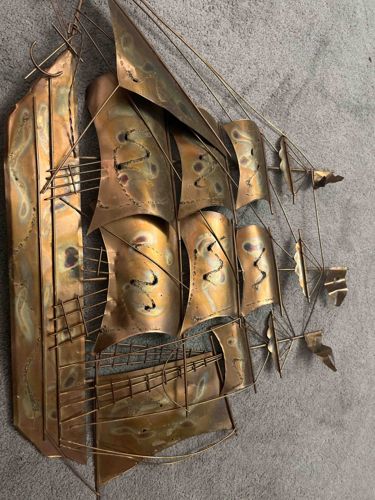
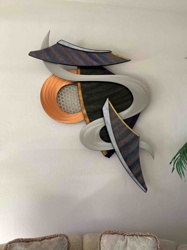
This is a vintage three-dimensional metal wall sculpture depicting a sailing ship, likely a galleon or a tall ship, characterized by its multiple masts and sails. The sculpture is constructed primarily from various gauges of brass or copper sheeting and wire, giving it a rich, warm metallic hue. The sails, represented by larger, rounded sheets of metal, display a unique patinated finish with varied tones of gold, brown, and hints of green and black, suggesting natural oxidation or an applied chemical treatment to create an aged appearance. Some sails feature abstract, flame-like cutouts or markings, adding to their visual texture. The rigging and masts are formed from thinner metal rods and wires, meticulously bent and soldered or joined to create the intricate details of the ship's structure, including ladder-like elements. The hull of the ship is less defined, merging abstractly into the overall design, with some sections appearing as flat sheets that have been cut and shaped. The piece exhibits a mid-century modern aesthetic, likely dating from the 1960s or 1970s, which was a popular period for such dimensional metal art. The 'Made in Hong Kong' context further supports this age as Hong Kong was a significant manufacturing hub for decorative items during that era. Visible condition issues include areas of darker patination, which are likely intentional but could also be natural aging or handling marks. The thin metal wires forming the rigging appear somewhat fragile and may have minor bends or slight distortions, but no significant breaks or missing pieces are immediately apparent. The overall craftsmanship suggests a mass-produced decorative item, yet with sufficient attention to detail to create an engaging visual piece. The construction relies on bending, cutting, and welding/soldering metal components to achieve the layered and volumetric effect.
AI Appraisal Report
After a thorough visual examination of the provided image, this vintage brass/copper wall sculpture of a sailing ship, marked 'Made in Hong Kong,' exhibits characteristics common to decorative metal art from the mid-20th century, likely the 1960s-1970s. The varied patination on the sails, with its gold, brown, and green tones, appears to be an intentional artistic treatment to simulate age, rather than solely natural oxidation. The craftsmanship, while detailed, suggests mass production, typical for decorative items from Hong Kong during that period.
Condition appears good based on the image; minor distortions in the thin wire rigging are noted but not unexpected for a piece of this age and material. No significant breaks or missing components are evident.
Market conditions for such vintage metal wall art are generally stable, with a moderate collector base. Comparable sales for similar 'Made in Hong Kong' metal sculptures of ships or other subjects from this era typically fall within the decorative art segment, not fine art. Demand is consistent but not high-flying, reflecting its categorization as a decorative accent rather than a rare collectible. Its 'Mid-Century Modern' aesthetic provides some appeal within current design trends.
Factors impacting value include its good visual condition, the appealing size for wall display, and its vintage charm. However, its mass-produced nature and lack of an established artist limit its ceiling value. Rarity is low; these pieces were produced in quantity.
Limitations in authenticity verification from images alone are significant. While the 'Made in Hong Kong' mark aligns with visual characteristics of items from that era, true authenticity regarding material composition (brass vs. copper) and any potential repairs would require in-person examination. Physical inspection would allow for detailed material analysis, assessment of solder joints, and verification of the integrity of the rigging. Provenance documentation, such as original sales receipts, could further confirm its age and origin, but this is rarely available for such items.