Yadkin Triangular Projectile Point
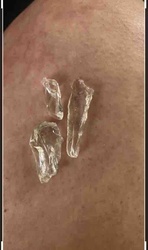
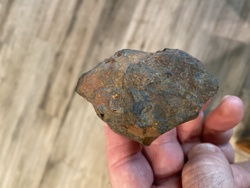
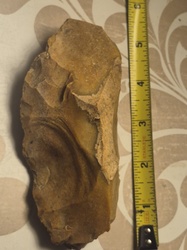
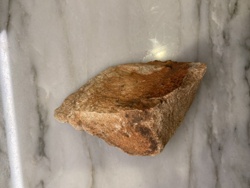
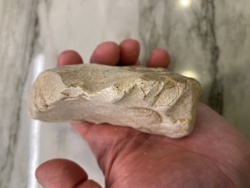
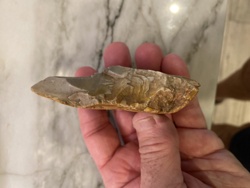
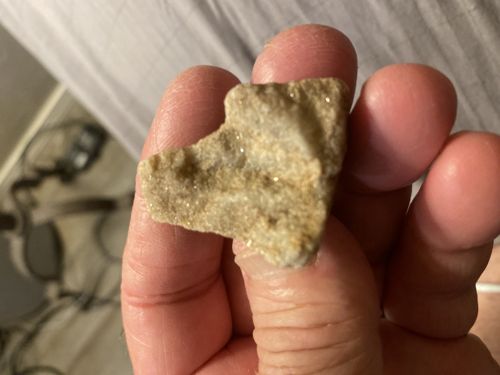
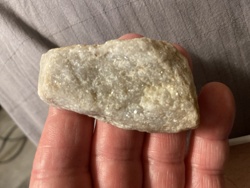
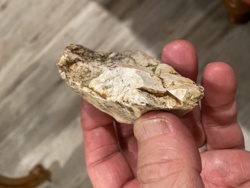
This is a lithic artifact consistent with a Yadkin triangular projectile point, measuring approximately 1 inch by 1 inch. The item is manufactured from a grainy, light-tan to buff-colored quartzite, a material known for its durability but difficulty in pressure flaking, which contributes to the somewhat rugged and translucent crystalline surface texture visible in the image. Its morphology is characterized by a broad, equilateral to isosceles triangular shape with slightly convex to straight lateral edges. The base is notably concave, a diagnostic feature of the Yadkin typology, which typically dates to the Middle to Late Woodland period (approx. 500 BC to 500 AD). The craftsmanship displays percussion flaking with some secondary retouch along the edges, though the coarse nature of the quartzite obscures fine detail. The condition appears stable with expected age-related weathering and oxidation of the stone surface; there are no major modern fractures or fresh chips, suggesting an authentic aged patina. The find location in Guthrie, Oklahoma, provides significant geographic context for assessing regional variations in lithic material usage.
AI-Generated Appraisal Disclaimer
Estimated Value
$30.00 - $65.00
Basic Information
Category
Archeological Artifacts / Native American Lithics
Appraised On
March 6, 2026
Estimated Value
$30.00 - $65.00
Additional Details Provided By Owner
User Provided Information
Projectile point quartzite Yadkin triangular point found in Guthrie OK 1" x 1"
Item Description
This is a lithic artifact consistent with a Yadkin triangular projectile point, measuring approximately 1 inch by 1 inch. The item is manufactured from a grainy, light-tan to buff-colored quartzite, a material known for its durability but difficulty in pressure flaking, which contributes to the somewhat rugged and translucent crystalline surface texture visible in the image. Its morphology is characterized by a broad, equilateral to isosceles triangular shape with slightly convex to straight lateral edges. The base is notably concave, a diagnostic feature of the Yadkin typology, which typically dates to the Middle to Late Woodland period (approx. 500 BC to 500 AD). The craftsmanship displays percussion flaking with some secondary retouch along the edges, though the coarse nature of the quartzite obscures fine detail. The condition appears stable with expected age-related weathering and oxidation of the stone surface; there are no major modern fractures or fresh chips, suggesting an authentic aged patina. The find location in Guthrie, Oklahoma, provides significant geographic context for assessing regional variations in lithic material usage.
Related Tags
Get Your Items Appraised
Instant estimates of your treasures with AI-powered instant appraisals