AI estimate as of November 20, 2025 · verify with a professional before acting
AI-Generated · Verify before acting
Everything on this page is generated by AI for informational purposes only. AI can make mistakes — the AI may misidentify items or misattribute them (artist, maker, brand, designer, origin, era). This is not an official valuation and should not be used for insurance, sale, tax, estate, legal, or lending purposes — or any decision requiring a certified appraisal. It is not an authoritative claim about any person, brand, or rights holder — do not share or rely on it as a factual statement about a third party. Always consult qualified professionals before making financial decisions.
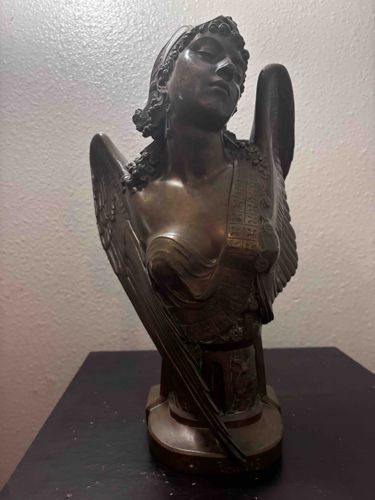
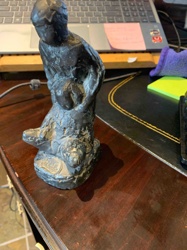
This item is a bronze or bronzed metal bust depicting a female figure with prominent wings, strongly suggesting an Egyptian Revival aesthetic. The figure is shown from the chest up, with a regal and somewhat contemplative or melancholic expression. Her hair is intricately styled in ringlets, possibly adorned with a diadem or headpiece that is partially covered by a band. The bust's most striking features are the large, stylized wings that extend upwards and outwards from her back, creating a dynamic silhouette. Her attire includes a drapery across her chest, which appears to feature incised or raised hieroglyphic-like symbols, reinforcing the Egyptian theme. Below her proper left wing (viewer's right), there's a visible section that could represent part of a columnar or architectural element, often associated with Sphinx figures. The material appears to be a patinated bronze or a bronze-finished pot metal, presenting a warm, dark brown coloration with lighter highlights on raised areas, indicating some wear or intentional finishing to mimic aged bronze. The surface exhibits a smooth quality on the skin with textured details on the hair and wings. There are some visible dust particles, especially on the base and the tabletop beneath, suggesting it has been displayed. The overall condition appears to be good with a consistent patina, though closer inspection might reveal minor nicks or scratches commensurate with age. The base is an integral part of the sculpture, rectangular with a rounded front edge, and a signature or mark 'FRANÇOIS' is discernible on the front of the base. This piece likely dates from the late 19th to early 20th century, a period when Egyptian iconography was popular in decorative arts.
AI Appraisal Report
Upon visual examination of the image, this Egyptian Revival winged bust, signed 'FRANÇOIS', presents as a compelling example of the genre, likely dating to the late 19th or early 20th century. My assessment of its condition, based solely on the visual information, is very good; the patina appears consistent and well-preserved, with natural wear indicating age rather than significant damage. The intricate details of the hair, wings, and hieroglyphic-like symbols are sharp, suggesting a quality casting. The signature 'FRANÇOIS' on the base is a significant factor, as works by artists such as François Raoul Larche or François-Émile Decorchemont, whose styles align with this period and aesthetic, command strong prices. However, without a clear initial or further identifying marks, pinpointing a specific sculptor from the image alone is a limitation.
Market conditions for quality Egyptian Revival pieces remain robust, particularly those with artistic merit and a recognizable signature. Comparables for signed, figurative bronze or bronzed spelter busts from this period often fall into the multi-hundred to low-thousand dollar range, with more prominent artists achieving higher figures. Demand is steady among collectors of Art Nouveau, Art Deco, and period decorative arts. The piece's rarity stems from its specific iconography and apparent quality.
Factors significantly impacting value include the artistic quality, the signature, and the condition. The warm patination and detailed sculpting are strong positives.
Limitations in authenticity verification from images alone are substantial. While the piece appears genuine, full authentication would require in-person examination to verify the material (bronze vs. bronzed spelter), inspect for repairs or restorations, confirm the casting method, and more definitively identify the signature through comparison with known examples. Provenance documentation, if available, would significantly enhance its value and confirm its history. Scientific testing of the metal composition would provide absolute certainty regarding the material.