These notes were written by the person who submitted this item. Appraiser.AI has not verified them, and the AI's identification and estimate may rely on them.
AI Estimated Value
Not an official valuation
$300-500
AI estimate as of October 4, 2025 · verify with a professional before acting
AI-Generated · Verify before acting
Everything on this page is generated by AI for informational purposes only. AI can make mistakes — the AI may misidentify items or misattribute them (artist, maker, brand, designer, origin, era). This is not an official valuation and should not be used for insurance, sale, tax, estate, legal, or lending purposes — or any decision requiring a certified appraisal. It is not an authoritative claim about any person, brand, or rights holder — do not share or rely on it as a factual statement about a third party. Always consult qualified professionals before making financial decisions.
This analysis also relies on unverified notes provided by the user, which may be incomplete or inaccurate and could affect the result.
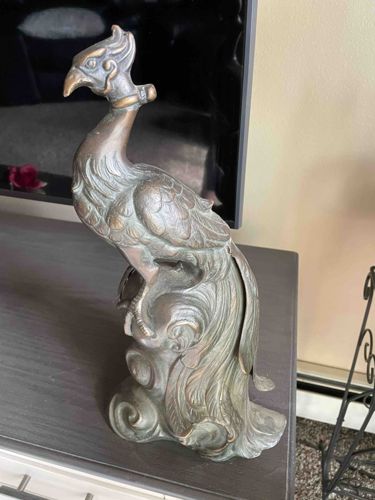
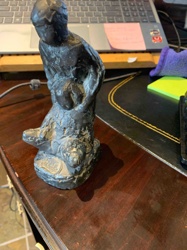
This appears to be a bronze or bronze-patinated metal sculpture depicting a phoenix, a mythical bird frequently associated with rebirth and renewal, particularly in Eastern cultures. The sculpture stands upright, showing the phoenix with its head turned to the left. The bird features a distinctive crest atop its head and a prominent, slightly hooked beak. Its neck, while relatively slender, is adorned with what appears to be a collar or decorative band positioned just below the head. The body of the phoenix is richly textured, with individual feathers clearly delineated on the wings and upper body, conveying a sense of depth and realism. The tail feathers are quite long and flow downwards, forming an integral part of the base, creating an elegant and stable foundation for the sculpture. These tail feathers are not merely decorative but seem to incorporate stylized swirling cloud or wave motifs, adding to the dynamic visual composition and possibly referencing water or air elements often associated with mythical creatures. The material exhibits a dark, aged patina, suggesting either actual antique bronze or a manufactured finish designed to mimic such an appearance. The surface shows minor wear consistent with handling and display, with some lighter areas potentially indicating rubbed spots or more recent exposure to light, revealing a slightly brighter metallic undertone. No apparent damage such as cracks, breaks, or significant repairs are visible. The craftsmanship appears to be of good quality, with attention to detail in the feathering and the overall form. Without discernible maker's marks or signatures, its precise origin or age is difficult to determine, but the style suggests an East Asian cultural influence, possibly a decorative piece from the early to mid-20th century or a contemporary piece made in a traditional style. The substantial appearance indicates it is a solid or heavily cast item.
AI Appraisal Report
Upon examining the provided image and description of this bronze phoenix sculpture, I assess its condition as good, showing minor wear consistent with display but no visible damage like cracks or breaks. The dark, aged patina appears intentional, mimicking antique bronze, though some lighter areas suggest minor handling or rub wear. The craftsmanship, particularly the detailed feathering, is commendable.
This piece resonates with East Asian aesthetic traditions, influencing its design. While the origin isn't definitively pinpointed, such sculptures are generally popular in decorative arts markets, particularly among collectors of Asian-inspired decor or mythical creature representations. Demand for well-crafted, visually appealing bronze pieces remains fairly consistent. However, without maker's marks or provenance, its rarity is difficult to ascertain, likely placing it in the category of decorative rather than fine art. Comparables in the market, often decorative bronzes of similar style and size, typically retail between $200 and $600, with higher values reserved for authenticated antiques or pieces by known artists.
Several factors impact its value. The lack of a discernible signature or history limits its value as an antique of specific origin. Its decorative appeal, good condition, and material (assuming it is indeed bronze or a high-quality bronze-patinated metal) are positive contributors. For a full authentication, an in-person examination would be crucial to confirm the metal composition, casting methods, and detailed surface characteristics. Verification of provenance documentation would be ideal, and scientific testing could definitively determine alloy composition and age. Based on the visual information alone, I appraise this Bronze Phoenix Sculpture at a value of $300-500.