AI estimate as of August 14, 2025 · verify with a professional before acting
AI-Generated · Verify before acting
Everything on this page is generated by AI for informational purposes only. AI can make mistakes — the AI may misidentify items or misattribute them (artist, maker, brand, designer, origin, era). This is not an official valuation and should not be used for insurance, sale, tax, estate, legal, or lending purposes — or any decision requiring a certified appraisal. It is not an authoritative claim about any person, brand, or rights holder — do not share or rely on it as a factual statement about a third party. Always consult qualified professionals before making financial decisions.
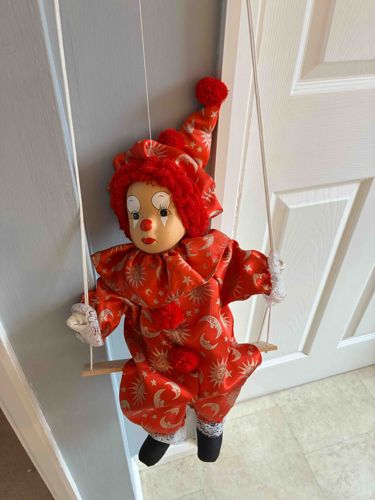
This item is a decorative clown doll, likely a shelf-sitter or hanging ornament, depicting a clown figure. The doll features a porcelain or ceramic head with painted facial features common to clown aesthetics, including white face paint, penciled eyebrows, an orange-red nose, and red lips. The clown has a vibrant red, curly 'hair' made of a fibrous material, possibly yarn or similar synthetic fibers, adding to its character. It wears a brightly colored, patterned suit primarily in a reddish-orange hue, adorned with repeated gold or light-colored motifs resembling suns and crescent moons, giving it a celestial theme. The suit has ruffled details around the neck and wrists, indicating a playful, elaborate design. Two prominent red pom-poms serve as buttons on the front of the costume. The hat, matching the suit's fabric and pattern, is conical with a red pom-pom at its tip and features a ruffled brim matching the 'hair' material. The hands appear to be made of a similar material to the face, while the feet are covered in black fabric, possibly felt, concluding the outfit with white lace trim visible at the ankles. The doll is suspended on a small, light-colored wooden swing, suggesting it is designed to be hung or positioned in a way that highlights its swinging motion. Thin white strings connect the swing to an unseen support structure above. The overall condition appears good, with no immediately visible significant damage or wear; the colors are vibrant, and the materials seem intact. It exhibits characteristics of a mass-produced collectible or decorative item, possibly from the late 20th or early 21st century.
AI Appraisal Report
I have examined the image of this Clown Doll on Wooden Swing. Based on visual inspection, the doll appears to be in good condition with vibrant colors and intact materials, consistent with a well-preserved decorative item. The design suggests it is a mass-produced collectible, likely from the late 20th or early 21st century. The porcelain/ceramic head, fabric body, and fiber hair are typical of such items. The wooden swing is a charming addition, indicating its intended display as a hanging ornament.
In terms of market conditions, items like this clown doll generally fall into the decorative collectible category, which has seen fluctuating demand. While cute and whimsical, clown-themed collectibles, especially those without significant artistic merit or designer provenance, typically hold modest value. Comparables for similar decorative dolls of this era, not associated with a major brand or artist, usually sell in the range of $10 to $30. Higher values are rare and often depend on unique features, limited editions, or historical significance, none of which are evident here.
Factors impacting value include its good condition, but also its common design and lack of rarity. The demand for such specific clown-themed decorative items is niche. Without any discernible maker's mark, signature, or original packaging, it's difficult to verify specific authenticity or origin beyond visual assessment. For full authentication and to ascertain potential hidden flaws, an in-person examination would be crucial to check material quality, internal structure, and hidden markings. Provenance documentation, if available, would further clarify its history and manufacturing details.