AI estimate as of June 27, 2025 · verify with a professional before acting
AI-Generated · Verify before acting
Everything on this page is generated by AI for informational purposes only. AI can make mistakes — the AI may misidentify items or misattribute them (artist, maker, brand, designer, origin, era). This is not an official valuation and should not be used for insurance, sale, tax, estate, legal, or lending purposes — or any decision requiring a certified appraisal. It is not an authoritative claim about any person, brand, or rights holder — do not share or rely on it as a factual statement about a third party. Always consult qualified professionals before making financial decisions.
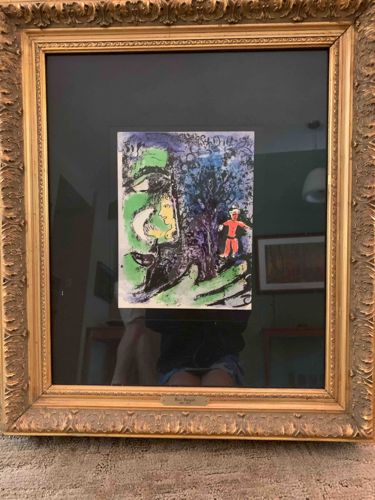
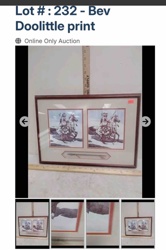
The item is a framed art print, likely a reproduction, featuring a colorful and abstract composition. The art piece itself appears to be a smaller print, approximately 8-10 inches in height, with a dominant color palette of green, purple, blue, and black, accented with white, yellow, and red. The imagery depicts a fantastical scene with abstract figures and organic shapes; a prominent feature is a large green shape on the left that resembles a distorted face or profile, and a tree-like structure with blue foliage on the right next to a small, red-orange human-like figure. The style is reminiscent of modernist or surrealist art, commonly associated with artists like Marc Chagall, whose name appears on a small plaque at the bottom of the frame. The print is housed within a substantial, ornate gilded gold frame. The frame has intricate carvings, possibly gesso over wood, with a distressed or antique finish, showing some minor wear consistent with age, such as slight chipping or rubbing on the raised areas. The print is matted with a dark, possibly black or dark grey, mat board, which creates a significant border around the art, suggesting the print itself is relatively small compared to the overall framed dimensions. The entire piece is under glass, which exhibits reflections from the surrounding room, obscuring some details but providing visual confirmation of the protective glazing. The overall craftsmanship of the frame is indicative of a decorative piece, likely intended for display in a living or dining area. The condition appears good overall, with no obvious major damage to the print itself or significant disrepair to the frame, beyond minor aesthetic wear expected from an older decorative item.
AI Appraisal Report
Upon visual examination of the provided image, I assess this framed art print, stylistically reminiscent of Marc Chagall, to be in good overall condition. The print itself appears well-preserved under glass, though reflections obscure precise detail. The ornate gilded frame, likely gesso over wood, shows minor wear consistent with age, such as slight chipping and rubbing on raised areas, which is expected for a decorative piece of this nature. The dark mat board nicely complements the artwork.
From images alone, authenticating the print as a genuine Chagall is impossible, especially given the common practice of attributing prints "in the style of" without proper provenance. The small plaque bearing Chagall's name is unlikely to denote authenticity of an original work; rather, it suggests it's a decorative reproduction. True Chagall prints (lithographs, etchings, etc.) would typically have edition numbers, artist's signatures, and documented provenance. Without physical examination, I cannot confirm the print medium – whether it's a reproduction of a painting, a poster print, or a limited-edition lithograph, which drastically impacts value. Factors significantly impacting value include the actual printing method, whether it's an authenticated limited edition, and its provenance.
Market conditions for decorative art prints vary. While Chagall is highly sought after, this piece is likely a commercially produced decorative print inspired by his style, not an original or numbered print. Demand for such decorative pieces is moderate, typically purchased for aesthetic appeal rather than investment. Rarity is low for this type of reproduction.
For full authentication and accurate valuation as a potential original or limited edition print, an in-person examination would be crucial to inspect the print medium (e.g., dot matrix, paper type, signature), search for edition numbers, and verify the physical quality of the print. Provenance documentation (certificates of authenticity, sales records) and potentially scientific testing (e.g., ink analysis) would be essential to confirm authenticity beyond a decorative reproduction.