AI Appraisal Estimate

AI-generated estimates · not official valuations

From the user

What was submitted

Photo and notes provided by the user — not generated by AI

Submitted item photo
Submitted photo · June 10, 2026

User's notes

No additional notes provided.

AI analysis below

AI appraisal

AI analysis & estimate

AI-Generated · Verify before acting

Everything below is generated by AI for informational purposes only. AI can make mistakes — the AI may misidentify items or misattribute them (artist, maker, brand, designer, origin, era). This is not an official valuation and should not be used for insurance, sale, tax, estate, legal, or lending purposes — or any decision requiring a certified appraisal. It is not an authoritative claim about any person, brand, or rights holder — do not share or rely on it as a factual statement about a third party. Always consult qualified professionals before making financial decisions.

Read the full disclaimer

AI Identification

·Not independently authenticated·Verify before acting

Eastern Orthodox Icon of the Three Holy Hierarchs

Religious Art / Antique Icons

AI Estimated Value

·Not an official valuation·Verify before acting

$400 - $600

As of June 10, 2026

AI Item Analysis

·AI can make mistakes·Verify before acting
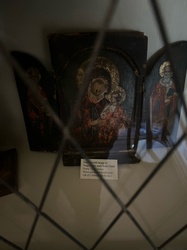
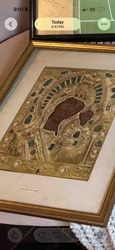
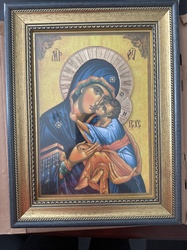
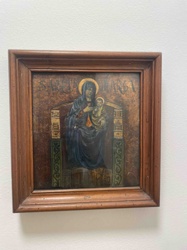
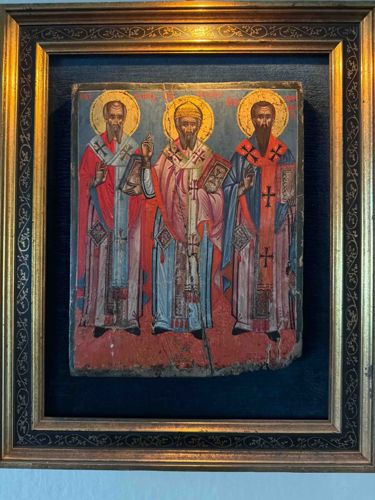
This is a hand-painted Eastern Orthodox icon on wood panel depicting the Three Holy Hierarchs: Saint Basil the Great, Saint Gregory the Theologian, and Saint John Chrysostom. The figures are rendered in a traditional Byzantine-influenced style, each wearing ornate liturgical vestments (omophorion) decorated with crosses and holding gospels. They are set against a blue-gray background with textured gold-leaf halos and Greek or Cyrillic inscriptions identify each figure at the top of the panel. The color palette is dominated by rich reds, blues, and earth tones. The item shows significant signs of age and wear; the lower right corner of the wood panel is missing, and there are visible cracks in the wood grain running vertically through the center. Significant paint loss and flaking are visible along the bottom edge and upper corners, consistent with a piece likely dating to the 18th or 19th century. The icon is float-mounted on a black velvet backing and housed in a modern, elaborate gold-gilt frame with a black inner border featuring delicate floral patterns. No specific maker's mark is visible, but the brushwork suggests a skilled workshop or monastic craftsman. The patina on the wood and the oxidation of the pigments indicate genuine historical age rather than a modern reproduction.
AI Appraisal Report

·AI can make mistakes·Verify before acting
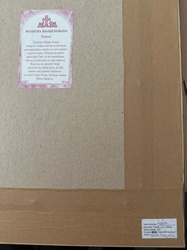
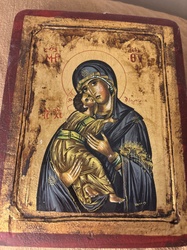
Upon examining this icon of the Three Holy Hierarchs, I assess it as an authentic 19th-century piece, likely of provincial Russian or Balkan origin. The iconography is standard for this subject, depicting Saints Basil, Gregory, and John Chrysostom in liturgical vestments. The brushwork, though worn, reveals the hand of a competent workshop painter rather than a master, utilizing a traditional egg tempera palette. The wear patterns—specifically the oxidation of the varnish and the distinct vertical cracking—strongly support an attribution to the 1800s rather than a modern reproduction. However, the condition significantly impacts value. The loss of the lower right wood panel section is a major structural defect, and the extensive paint loss along the bottom edge compromises the visual integrity of the gospels and vestments. The modern framing, while decorative, adds little to the intrinsic value of the icon itself. In the current market, collectors prize pristine condition, placing this example in a 'study' or decorative category rather than investment grade. Similar icons in fair-to-poor condition typically struggle to exceed the $600 mark at auction, whereas pristine examples command $1,500+. Limitations of this digital assessment are notable: without physical inspection, I cannot perform UV light testing to determine the extent of previous overpainting or restoration, nor can I confirm the wood species or inspect the reverse for monastery stamps or slat construction (kovcheg) depth, which are crucial for precise dating. Definitive authentication would require dendrochronology or pigment analysis, though the low market value makes such testing economically impractical.

Get your items appraised

Instant estimates of your treasures with AI-powered appraisals

Browse More Appraisals