AI estimate as of August 11, 2025 · verify with a professional before acting
AI-Generated · Verify before acting
Everything on this page is generated by AI for informational purposes only. AI can make mistakes — the AI may misidentify items or misattribute them (artist, maker, brand, designer, origin, era). This is not an official valuation and should not be used for insurance, sale, tax, estate, legal, or lending purposes — or any decision requiring a certified appraisal. It is not an authoritative claim about any person, brand, or rights holder — do not share or rely on it as a factual statement about a third party. Always consult qualified professionals before making financial decisions.
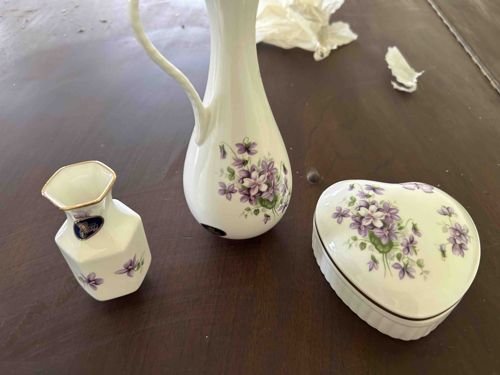
This image features a collection of three decorative items, likely made of porcelain or fine ceramic, characterized by their white base color and consistent violet floral motif. The set appears to include a small octagonal vase, a pitcher-style vase or creamer, and a heart-shaped lidded box. All pieces exhibit a hand-painted or decal application of clusters of purple violets with green leaves, suggestive of a common design theme or pattern. The small octagonal vase has a hexagonal opening with a gold rim, adding a touch of elegance. A dark blue or black label with white text, possibly a maker's mark or collection name, is visible on one of its facets. The taller pitcher-like item also features the violet pattern and a delicate handle, typical of a creamer or a small decorative pitcher. The heart-shaped box has a smooth, rounded lid adorned with the same floral pattern and a dark, possibly gold or black, rim along the edge where the lid meets the base. The overall condition appears to be very good with no obvious chips, cracks, or significant wear visible from the provided angles. The consistent design and apparent quality suggest these items could be part of a coordinated set, possibly from a manufacturer specializing in decorative homeware or collectibles. The style points towards a traditional or vintage aesthetic, perhaps from the mid-20th century or later.
AI Appraisal Report
Upon examining the provided image of the Set of Three Violet-Patterned Porcelain Decorative Items, I can assess their condition and authenticity to a certain extent. Visually, the items appear to be in very good condition, with no visible chips, cracks, or significant wear. The consistent violet floral motif and white base suggest they are a coordinated set, likely from a single manufacturer. The gold rim on the octagonal vase and the overall delicate features point to a certain level of craftsmanship.
However, it is crucial to note the limitations of image-only appraisal. Authenticity, maker, and precise age cannot be definitively determined from photographs alone. The dark blue label on the octagonal vase is unreadable, preventing identification of the manufacturer or origin. Without deciphering this mark, identifying comparable items or established market values for similar sets becomes speculative. This limits the ability to assess rarity or robust market demand accurately.
Market conditions for decorative porcelain wares of this style are generally stable but not experiencing rapid appreciation unless attributed to highly sought-after manufacturers or renowned artists. Without a verifiable maker's mark or provenance, these items would likely be categorized as general decorative collectibles rather than high-value antiques.
To conduct a full authentication and provide a more precise appraisal, an in-person examination is essential. This would involve inspecting the porcelain for translucency, examining glazes for crazing consistent with age, closely scrutinizing manufacturing techniques (e.g., hand-painting vs. decal application), and, most importantly, identifying and analyzing any maker's marks or stamps. Provenance documentation, such as original purchase receipts or certificates of authenticity, would also significantly impact value. Scientific testing, while usually reserved for high-value items, could involve material analysis if specific questions about the porcelain composition arose.