AI Appraisal Estimate

AI-generated estimates · not official valuations

From the user

What was submitted

Photo and notes provided by the user — not generated by AI

Submitted item photo
Submitted photo · June 20, 2026

User's notes

No additional notes provided.

AI analysis below

AI appraisal

AI analysis & estimate

AI-Generated · Verify before acting

Everything below is generated by AI for informational purposes only. AI can make mistakes — the AI may misidentify items or misattribute them (artist, maker, brand, designer, origin, era). This is not an official valuation and should not be used for insurance, sale, tax, estate, legal, or lending purposes — or any decision requiring a certified appraisal. It is not an authoritative claim about any person, brand, or rights holder — do not share or rely on it as a factual statement about a third party. Always consult qualified professionals before making financial decisions.

Read the full disclaimer

AI Identification

·Not independently authenticated·Verify before acting

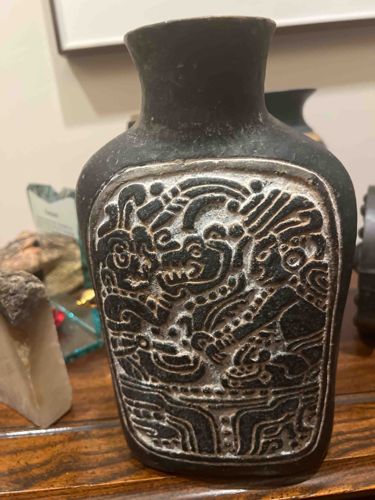
Maya-Style Bas-Relief Ceramic Vase with Anthropomorphic Glyphs

Art & Collectibles / Decorative Ceramics

AI Estimated Value

·Not an official valuation·Verify before acting

$150 - $250

As of June 20, 2026

AI Item Analysis

·AI can make mistakes·Verify before acting
This item is a decorative ceramic vase featuring a prominent rectangular panel with white-inlay bas-relief carvings in a Neo-Mayan or Mesoamerican revival style. The vessel possesses a flattened, flask-like body with rounded shoulders and a short, slightly flared neck. It is constructed from a dark, matte-finished ceramic material, likely a black-fired clay or a dark slip-covered stoneware. The central relief panel depicts stylized anthropomorphic figures and mythological monsters, rendered with complex linework characteristic of Maya hieroglyphic art. The raised portions are black, while the recessed background is filled with a textured white or light-grey pigment to provide high contrast. Regarding condition, there is visible chipping along the rim and surface scuffing on the shoulders, revealing a lighter clay body beneath the dark finish. There are no immediate signs of a maker's mark or signature visible in the current view, suggesting it may be a mid-20th-century souvenir or high-quality decorative piece. The craftsmanship shows intentional antiquing and a rough, tactile texture designed to mimic high-relief stone carvings. The style suggests a 20th-century production date, possibly from Mexico or Central America, catering to the interest in pre-Columbian aesthetics.

AI Appraisal Report

·AI can make mistakes·Verify before acting
I have virtually examined this Maya-Style Bas-Relief Ceramic Vase. The vessel exhibits the aesthetics of the Mesoamerican Revival movement, likely produced in the mid-to-late 20th century. My visual assessment confirms the piece is a decorative 'souvenir' or 'revival' work rather than a pre-Columbian antiquity. This is evidenced by the specific application of white-inlay pigment to create modern high-contrast relief and the visible lighter clay body beneath the dark slip at the chips, which is inconsistent with ancient firing techniques. The condition is fair to good; while the bas-relief remains legible, the significant chipping on the rim and scuffing on the shoulders detract from its display value. Market demand for Mayan-style decorative ware remains steady among interior designers and collectors of folk art, though it lacks the premium associated with signed artist pieces or genuine archaeological artifacts. Comparable mid-century Mexican studio pottery of this scale typically realizes prices in the low hundreds at auction. The value is primarily driven by its decorative appeal rather than rarity. Note that this appraisal is based solely on digital images. A definitive assessment of age and construction would require in-person inspection to evaluate the paste composition and tactile weight. To rule out any potential 19th-century origin or to verify the specific studio, provenance documentation or a physical examination of the interior and base for hidden marks would be necessary. Scientific testing, such as thermoluminescence, would only be recommended if there were evidence suggesting it originated from an earlier historical period.

Get your items appraised

Instant estimates of your treasures with AI-powered appraisals

Browse More Appraisals