AI identification & appraisal estimate

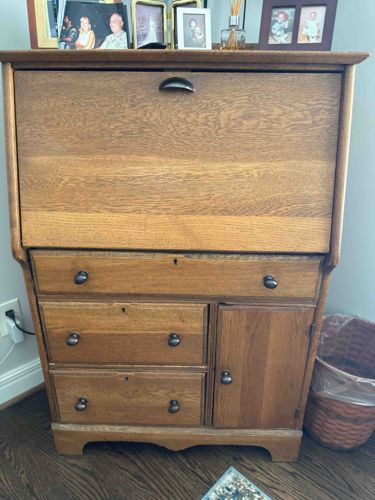
Quartersawn Oak Drop-Front Secretary Desk

This name is the AI's identification of the item — it may be incorrect.

Submitted photo of Quartersawn Oak Drop-Front Secretary Desk
Photo submitted by the user — not generated by AI

User's notes

Bobbi Kerth 30/300

These notes were written by the person who submitted this item. Appraiser.AI has not verified them, and the AI's identification and estimate may rely on them.

AI Estimated Value

Not an official valuation

$650.00 - $950.00

AI estimate as of January 26, 2026 · verify with a professional before acting

AI-Generated · Verify before acting

Everything on this page is generated by AI for informational purposes only. AI can make mistakes — the AI may misidentify items or misattribute them (artist, maker, brand, designer, origin, era). This is not an official valuation and should not be used for insurance, sale, tax, estate, legal, or lending purposes — or any decision requiring a certified appraisal. It is not an authoritative claim about any person, brand, or rights holder — do not share or rely on it as a factual statement about a third party. Always consult qualified professionals before making financial decisions.

This analysis also relies on unverified notes provided by the user, which may be incomplete or inaccurate and could affect the result.

Read the full disclaimer

AI Item Analysis

This is a vintage drop-front secretary desk crafted from oak, featuring a prominent quartersawn grain (also known as tiger oak) on the slanted drop-front panel. The piece is constructed with an upright profile, featuring a top compartment that folds down to create a writing surface, secured by a dark metal cup-style pull. Below the writing desk, the base contains a multi-functional storage arrangement: one full-width drawer over a split configuration consisting of two narrower drawers on the left and a vertical cabinet door on the right. Dark-toned, mushroom-capped metal knobs are used throughout the drawer fronts, and keyholes atop the drawers suggest the presence of internal locking mechanisms. The grain patterns are diverse, with horizontal orientation on the drop-front and vertical orientation on the cabinet door. The desk rests on a simple plinth base with bracket feet and a slight decorative scallop. The overall style is reminiscent of early 20th-century Mission or Arts and Crafts influence, though the simple lines suggest a more utilitarian or provincial interpretation. Condition-wise, the piece appears to be in used but stable condition; there is visible wear and scuffing along the baseboard and lower edges of the drawers, consistent with age and frequent use. The finish shows a warm, medium-brown honey patina with some unevenness in color across different panels, likely due to light exposure and varying wood density. The context provided ('Bobbi Kerth 30/300') suggests this could be part of a numbered series or an artist-modified piece, though the furniture style itself is a classic American design from the 1900-1930 period.
AI Appraisal Report

Based on my visual examination of this quartersawn oak drop-front secretary desk, I find it to be a representative example of American utilitarian furniture from the early 20th century. The prominent 'tiger oak' grain on the writing surface is a sought-after feature of the Arts and Crafts era. The construction appears sound, though the scuffing and finish wear on the base and drawer edges indicate a lifetime of use. This patina, while authentic, suggests the piece would benefit from professional conservation to stabilize the finish. The notation 'Bobbi Kerth 30/300' is intriguing; as it is likely a modern artist's mark or a limited edition refurbishment tag, it does not currently add significant historical provenance but may appeal to a niche market of collectors interested in studio-modified furniture. Current market demand for Mission-style oak remains stable, though prices have softened from their peak in the 1990s. Comparables for similar mid-tier oak secretaries typically range between $500 and $1,100 depending on the level of interior compartmentalization. Limitations: This appraisal is based solely on digital images. A physical inspection is required to verify the integrity of the joinery (e.g., dovetails), the functionality of the locking mechanisms, and to confirm the lack of major structural repairs or core-wood substitutions. Scientific testing of the finish or hardware metallurgical analysis would be necessary to rule out high-quality 1970s-era reproductions. Full authentication would also require research into the specific 'Bobbi Kerth' attribution to determine if it relates to a documented mid-century artisan or a more recent decorative series.

Keep exploring

More antique & vintage furniture appraisals

Get your items appraised

Instant AI-powered appraisal estimates from a photo

Browse More Appraisals