AI Appraisal Estimate

AI-generated estimates · not official valuations

From the user

What was submitted

Photo and notes provided by the user — not generated by AI

Submitted item photo
Submitted photo · May 24, 2026

User's notes

No additional notes provided.

AI analysis below

AI appraisal

AI analysis & estimate

AI-Generated · Verify before acting

Everything below is generated by AI for informational purposes only. AI can make mistakes — the AI may misidentify items or misattribute them (artist, maker, brand, designer, origin, era). This is not an official valuation and should not be used for insurance, sale, tax, estate, legal, or lending purposes — or any decision requiring a certified appraisal. It is not an authoritative claim about any person, brand, or rights holder — do not share or rely on it as a factual statement about a third party. Always consult qualified professionals before making financial decisions.

Read the full disclaimer

AI Identification

·Not independently authenticated·Verify before acting

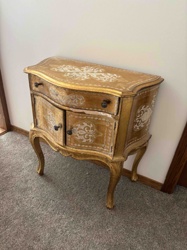
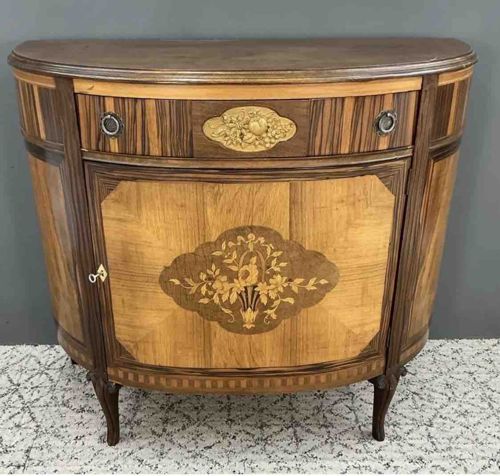
Neoclassical Style Demilune Commode with Marquetry Inlay

Antique & Vintage Furniture

AI Estimated Value

·Not an official valuation·Verify before acting

$1,200 - $1,800

As of May 24, 2026

AI Item Analysis

·AI can make mistakes·Verify before acting
This is a finely crafted demilune (half-moon) commode or side cabinet, likely dating from the mid-to-late 20th century in the Louis XVI Neoclassical style. The piece features a curved silhouette with a single central drawer over a large cupboard door. It is constructed with a variety of contrasting fruitwood and exotic wood veneers. The drawer front is decorated with vertical kingwood or rosewood banding and a central gilded ormolu plaque depicting a floral bouquet. The main door features an elaborate marquetry medallion showing a floral basket within an quatrefoil frame, surrounded by cross-banded veneers arranged in a geometric, ray-like pattern. Additional decorative elements include a checkered parquetry border along the bottom apron and matching curved side panels. The cabinet stands on short, cabriole-style legs. Notable hardware includes circular drop-ring pulls on the drawer and a visible skeleton key in the door lock. The condition appears fair to good; there is some noticeable wear on the wooden top surface including fading and potential water marks, along with minor scuffs and patina consistent with age and use. The intricate inlay work demonstrates high-level craftsmanship despite the piece likely being a later reproduction of an 18th-century French design.
AI Appraisal Report

·AI can make mistakes·Verify before acting
Based on my visual examination of this Louis XVI-style demilune commode, I identify it as a high-quality 20th-century revival piece. The construction utilizes sophisticated marquetry and parquetry techniques, specifically the central floral basket medallion and the rhythmic kingwood banding. The ormolu mounts and drop-ring pulls appear to be cast brass rather than fire-gilded bronze, which, along with the specific sheen of the lacquer, points to a mid-to-late 20th-century manufacture date rather than the late 18th century. The condition is fair to good. The primary valuation detractor is the visible surface wear on the top, including fading and water rings, which would require professional refinishing to restore its 'showroom' appeal. However, the inlay remains intact without significant lifting or loss, which is critical for value retention in marquetry furniture. The market for Neoclassical revival furniture remains steady for interior design purposes, though it lacks the 'blue chip' investment status of period 18th-century originals. Comparable sales for 20th-century European reproductions of this caliber typically range between $1,200 and $1,800 at auction. Limitations: This appraisal is based solely on digital images. A physical inspection is required to examine secondary woods (such as drawer liners and backboards) and joinery (dovetails vs. machine cuts) to definitively rule out an earlier 19th-century origin. For full authentication, I would recommend checking for maker’s stamps (e.g., Jansen or Linke) which could quintuple the value. Provenance documentation regarding its purchase history would also be necessary to elevate its status from a decorative object to a fine antique.

Get your items appraised

Instant estimates of your treasures with AI-powered appraisals

Browse More Appraisals