AI estimate as of October 30, 2025 · verify with a professional before acting
AI-Generated · Verify before acting
Everything on this page is generated by AI for informational purposes only. AI can make mistakes — the AI may misidentify items or misattribute them (artist, maker, brand, designer, origin, era). This is not an official valuation and should not be used for insurance, sale, tax, estate, legal, or lending purposes — or any decision requiring a certified appraisal. It is not an authoritative claim about any person, brand, or rights holder — do not share or rely on it as a factual statement about a third party. Always consult qualified professionals before making financial decisions.
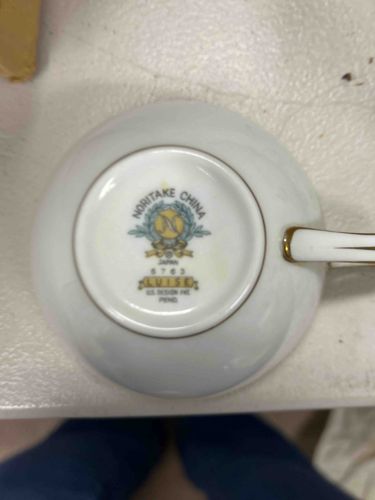
This item is a white porcelain tea or coffee cup, featuring a delicate gold-toned rim along the top edge and a gilded accent on the handle. The cup exhibits a classic, elegant design. The primary material is fine china, known for its translucence and durability. The visible base of the cup, which is slightly recessed, prominently displays the backstamp. The backstamp is a circular mark with 'NORITAKE' arching over the top and 'CHINA' arching below, enclosing a graphic of a stylized 'N' within a wreath. Below this, 'JAPAN', the pattern number '6763', and the pattern name 'LOUISE' are clearly legible. Further below, 'U.S. DESIGN PAT. PEND.' is also visible. The colors of the backstamp are primarily green, blue, and gold, indicating a specific Noritake production period. The craftsmanship appears to be of high quality, with smooth glazing and precise application of the gold accents. There are no immediate visible signs of cracks, chips, or significant wear on the visible portion of the cup, suggesting good overall condition. The style is indicative of mid-20th century dinnerware, likely aiming for a sophisticated, timeless aesthetic. The gold trim on the handle is a subtle yet elegant detail, enhancing the item's refined appearance. The presence of 'U.S. DESIGN PAT. PEND.' suggests a specific production timeframe, likely in the period following World War II when such patent notices were common for Japanese exports to the U.S.
AI Appraisal Report
Based on my visual examination of the provided image, this Noritake China 'Louise' Pattern Tea Cup/Coffee Cup appears to be in excellent condition. The gold-toned rim and gilded handle accent show no immediate signs of wear, and the white porcelain body appears free from chips, cracks, or crazing. The backstamp, with its clear ‘NORITAKE CHINA’ arching over and under the 'N' in a wreath, along with 'JAPAN', pattern number '6763', pattern name 'LOUISE', and 'U.S. DESIGN PAT. PEND.', confirms its authenticity as a Noritake piece. The presence of 'U.S. DESIGN PAT. PEND.' typically dates this piece to the post-WWII era, likely late 1940s to 1950s, when Noritake was re-establishing its export market to the United States. This timing aligns with the classic, elegant mid-century aesthetic of the cup. Market conditions for individual Noritake tea cups, even in excellent condition, are generally modest. While the 'Louise' pattern is attractive and well-executed, it is not considered rare among Noritake patterns. Comparables for single Noritake cups from this era in similar condition typically fetch between $15 and $25. Demand is primarily from collectors completing sets or individuals seeking replacement pieces. Factors impacting value positively are the pristine condition and clear backstamp. The primary limitation of this appraisal is the lack of physical examination. While the image shows good condition, an in-person inspection would allow for a tactile assessment of any subtle surface imperfections, microscopic crazing, or minor wear on the gold trim not visible in photographs. Provenance documentation, such as original purchase receipts, would further cement its history, though for common Noritake patterns, this isn't usually critical for authentication or value.