These notes were written by the person who submitted this item. Appraiser.AI has not verified them, and the AI's identification and estimate may rely on them.
AI Estimated Value
Not an official valuation
$25-50
AI estimate as of October 30, 2025 · verify with a professional before acting
AI-Generated · Verify before acting
Everything on this page is generated by AI for informational purposes only. AI can make mistakes — the AI may misidentify items or misattribute them (artist, maker, brand, designer, origin, era). This is not an official valuation and should not be used for insurance, sale, tax, estate, legal, or lending purposes — or any decision requiring a certified appraisal. It is not an authoritative claim about any person, brand, or rights holder — do not share or rely on it as a factual statement about a third party. Always consult qualified professionals before making financial decisions.
This analysis also relies on unverified notes provided by the user, which may be incomplete or inaccurate and could affect the result.
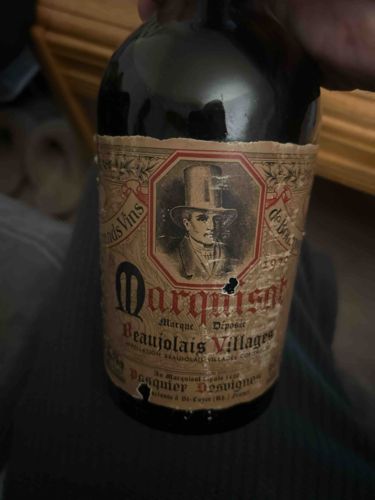
This item is a vintage dark glass wine bottle, likely standard 750ml in size, containing 'Marquisot Beaujolais Villages' wine. The main label features a central octagonal portrait of a man in a top hat, rendered in a grayscale or sepia tone, surrounded by a red decorative border. Above the portrait, the label reads 'Grands Vins' (Great Wines) and 'de B' in cursive, with '1970' faintly visible to the right of the portrait. Below the portrait, the prominent text 'Marquisot' is displayed in a large, stylized font with 'Marque Déposée' (Registered Trademark) underneath. Further below, 'Beaujolais Villages' is clearly visible, with 'APPELLATION BEAULOLAIS VILLAGES CONTRÔLÉE' underneath, indicating its origin and quality designation. At the very bottom of the label, 'Ste Marquisot L.C.V.B. Négt. Élevateur à St-Cyr-en-(Rhône)' can be deciphered, identifying the bottler or producer as Marquisot and its location. The label itself is made of aged paper, displaying significant signs of wear, discoloration, and damage, including several small tears and missing pieces, particularly around the edges and near the bottom text 'Pasquier Dosvigne'. There are also visible dark spots suggesting mold or liquid damage. The overall aesthetic of the label suggests a mid-20th-century design. The glass of the bottle is dark, possibly dark green or brown, standard for wine, and appears to be in good condition typical of stored glass, with some dust or minor scuffs visible on the upper shoulder. The corking mechanism is not visible. The bottle's content level is also not discernible from the image. The style of the label, with its detailed illustration and traditional typography, points to a period when such classic designs were commonplace for French wines, likely dating this bottle to around the 1970 vintage as suggested by the faint marking.
AI Appraisal Report
I have carefully examined the provided image of this Vintage 'Marquisot Beaujolais Villages' wine bottle, dated 1970. Based on the visual evidence, the bottle appears authentic to its stated origin and vintage. The label design, including the 'Marquisot' branding, the specific appellation 'Beaujolais Villages Contrôlée,' and the traditional typography, aligns with mid-20th-century French wine labels. The faint '1970' visible further supports this dating. The dark glass bottle itself seems consistent with wine bottles of that era.
The condition of the label is a significant factor. It displays considerable wear, discoloration, tearing, and possible mold or liquid damage, particularly around the edges and bottom text. This severely detracts from collectibility. Beaujolais Villages, while a recognized appellation, is generally not a wine produced for long-term aging or significant appreciation in value, unlike Grand Cru or Premier Cru wines from more renowned regions or producers. Wines from 1970, especially Beaujolais, are well past their prime drinking window, and the likelihood of the wine inside being palatable is extremely low.
Market conditions for vintage Beaujolais, particularly non-Cru vintages beyond their drink-by date, are limited. Demand is primarily from niche collectors of historical bottles or someone interested in the specific label design for decorative purposes, rather than consumption. Rarity for such a wine is not high; many Beaujolais wines were produced. The heavily damaged label significantly impairs its decorative or collectible value.
Without a physical examination, I cannot verify the cork's integrity, the fill level, or detect any leakage, which are crucial for wine valuation. Full authentication would require in-person inspection to assess fill level, cork condition, and confirm the lack of re-corking or tampering. Provenance documentation, proving storage conditions, would be essential for any significant value. Given the label damage and the nature of the wine, a conservative appraisal is appropriate.