AI estimate as of August 9, 2025 · verify with a professional before acting
AI-Generated · Verify before acting
Everything on this page is generated by AI for informational purposes only. AI can make mistakes — the AI may misidentify items or misattribute them (artist, maker, brand, designer, origin, era). This is not an official valuation and should not be used for insurance, sale, tax, estate, legal, or lending purposes — or any decision requiring a certified appraisal. It is not an authoritative claim about any person, brand, or rights holder — do not share or rely on it as a factual statement about a third party. Always consult qualified professionals before making financial decisions.
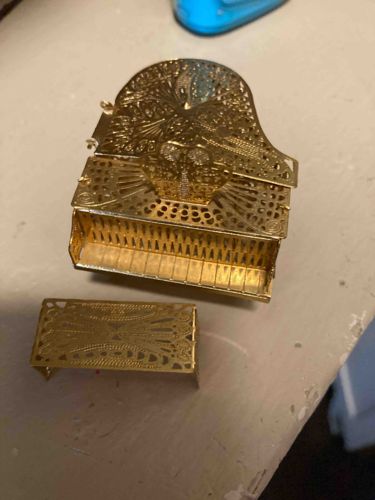
This item is a decorative miniature grand piano, likely a trinket box or a purely ornamental piece, crafted from what appears to be a gold-toned metal, possibly brass or plated alloy, given its reflective, warm metallic sheen. It measures approximately a few inches in length, consistent with a small collectible. The piano features intricate filigree and pierced metalwork throughout its construction. The lid of the piano is elaborately decorated with a central design that resembles a peacock, with its tail feathers fanning out, surrounded by scrolling foliage and geometric patterns. This highly decorative top suggests a focus on aesthetic appeal rather than functional realism. The sides and front of the piano body also exhibit delicate openwork patterns, possibly stylized musical notes or abstract motifs, which allow light to pass through. Inside the main body, where the keys of a real piano would be, there is a flattened, textured surface, indicating it's not a functional musical instrument or a fully detailed replica of the interior. The piece is accompanied by a separate rectangular component, also made of the same gold-toned metal and featuring similar intricate pierced patterns. This piece likely serves as a miniature bench or stool for the piano, reinforcing its decorative, scaled-down nature. The overall condition appears to be good, with no obvious signs of significant damage such as dents or breaks. There might be some minor surface wear or slight tarnish consistent with age and handling, visible as small dark spots or a slight dulling of the shine in certain areas. The craftsmanship suggests it may have been mass-produced with a focus on intricate design, possibly in the mid to late 20th century, a period when such decorative trinkets were popular. The delicate nature of the filigree work points to a degree of quality in its manufacture, although the material itself is likely not precious. It is a charming example of an allegorical or whimsical decorative object.
AI Appraisal Report
This Miniature Filigree Grand Piano with Bench, crafted from a gold-toned metal, appears to be in good overall condition. Based on the visual evidence, I observe no significant structural damage such as dents, breaks, or missing filigree elements. There may be minor surface wear, slight tarnish, or dulling of the finish consistent with age and handling, which is common for items of this type; however, these appear minimal and do not significantly detract from its ornamental appeal. The intricate filigree and pierced metalwork, particularly the peacock design on the lid, suggest a decorative piece likely dating from the mid to late 20th century.
Authenticity, in this context, refers to its nature as a decorative object rather than a functional musical instrument or a reproduction of a historical piece. Its construction, with a solid interior indicating no functional musical components, confirms its decorative purpose. Market comparables for similar vintage filigree trinket boxes or miniature ornaments show a steady but moderate demand. These items are generally not considered rare, as many were mass-produced. The value driver here is primarily its aesthetic appeal and good condition, rather than intrinsic material value or rarity.
Limitations: My assessment is based solely on the provided image. A physical examination would allow for a more precise assessment of surface condition, material composition (e.g., confirming brass or a specific alloy), and the presence of any maker's marks, which could potentially impact value. Provenance documentation, while unlikely for an item of this type, would offer insights into its history. Without a physical inspection, definitive confirmation of the exact metal composition or the precise manufacturing technique (e.g., hand-finished vs. entirely machine-made) remains speculative. However, for a decorative item of this nature, these details would likely not substantially alter the appraised value.