AI estimate as of September 8, 2025 · verify with a professional before acting
AI-Generated · Verify before acting
Everything on this page is generated by AI for informational purposes only. AI can make mistakes — the AI may misidentify items or misattribute them (artist, maker, brand, designer, origin, era). This is not an official valuation and should not be used for insurance, sale, tax, estate, legal, or lending purposes — or any decision requiring a certified appraisal. It is not an authoritative claim about any person, brand, or rights holder — do not share or rely on it as a factual statement about a third party. Always consult qualified professionals before making financial decisions.
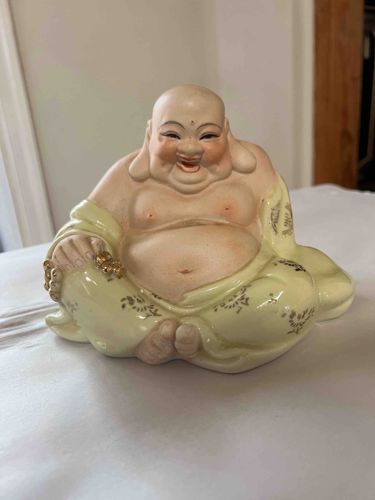
This is a porcelain figurine depicting Hotei, commonly known as the Laughing Buddha, shown in a relaxed, seated pose with crossed legs. The figurine features a dominant light cream or off-white color for the skin, with rosy blush applied to the cheeks, palms of the hands, and the soles of the feet, suggesting a vibrant, healthy complexion. The facial expression is one of joyful laughter, with a wide, open mouth, downturned eyes, and raised eyebrows, contributing to a benevolent and jovial demeanor. The figure is clad in a loose-fitting robe or shawl, rendered in a pale yellowish-green hue. This garment is adorned with delicate, repeating patterns in a metallic gold or bronze tone, suggesting intricate embroidery or printed designs. The patterns appear to be floral or abstract leaf motifs, adding an element of luxury and detail to the otherwise simple attire. In his right hand, the Buddha holds what appears to be a string of prayer beads or a small treasure, also rendered in a metallic gold or bronze color, consistent with the robe's embellishments. The porcelain appears to be glazed, giving it a smooth, glossy finish, indicative of standard ceramic production. There are no visible chips, cracks, or significant wear marks, suggesting the figurine is in good to excellent condition. The craftsmanship appears to be of good quality, with well-defined features and clean paint application. The style suggests it could be a a mid-20th century decorative piece, likely manufactured in Asia, given the subject matter and common production trends for such items.
AI Appraisal Report
Based on my visual examination of the provided image, this Seated Porcelain Laughing Buddha (Hotei) Figurine appears to be in very good to excellent condition, with no visible chips, cracks, or significant wear. The glazed finish suggests standard ceramic production. The craftsmanship seems of good quality with well-defined features and clean paint application. The style and subject matter suggest it is a decorative piece, likely manufactured in Asia, possibly mid-20th century, though dating precisely from an image is challenging.
Authenticity: While it presents as a genuine porcelain decorative item, I can only assess its visual characteristics. True authenticity (e.g., verifying its age, specific factory, or materials) would require in-person inspection. I cannot confirm if it's genuinely antique or a more modern reproduction without examining the base, internal structure, and the porcelain body for precise age indicators.
Market Conditions & Demand: The market for decorative Hotei figurines is generally steady but not high-value for mass-produced or modern items. Comparables for similar mid-20th century decorative porcelain figures indicate a modest value. Demand is moderate, primarily from those interested in Asian decor or spiritual iconography. Rarity is low, as many similar items were produced.
Factors Impacting Value: Its good condition is a positive factor. However, the lack of a known maker's mark or specific historical significance limits its premium value. Without provenance, it's assessed purely as a decorative object. A high-end, artistic, or antique (pre-20th century) lineage would significantly increase value.
Limitations: My assessment is entirely based on the image. A physical examination would allow me to check for marks, assess the weight and feel of the porcelain, detect any repairs, and potentially confirm the age through tactile and microscopic inspection. Provenance documentation, if available, would be crucial for establishing its history and confirming any claims of age or maker.