AI estimate as of July 21, 2025 · verify with a professional before acting
AI-Generated · Verify before acting
Everything on this page is generated by AI for informational purposes only. AI can make mistakes — the AI may misidentify items or misattribute them (artist, maker, brand, designer, origin, era). This is not an official valuation and should not be used for insurance, sale, tax, estate, legal, or lending purposes — or any decision requiring a certified appraisal. It is not an authoritative claim about any person, brand, or rights holder — do not share or rely on it as a factual statement about a third party. Always consult qualified professionals before making financial decisions.
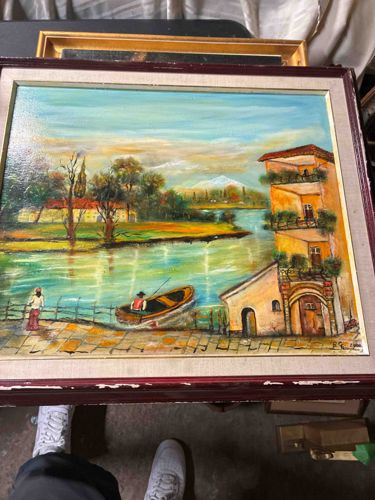
This item is an oil painting depicting a vibrant landscape scene, possibly a European river or lakeside village. The artwork features a serene body of water in the foreground and mid-ground, reflecting the light from a sky with hints of a sunset or sunrise, rendered in tones of blue, yellow, and orange. On the left side of the composition, there's a structure with a prominent steeple, indicative of a church or grand building, surrounded by lush trees, some with bare branches suggesting a late autumn or winter setting. The right side features a multi-story building, possibly a house or inn, with balconies and potted plants, showcasing an architectural style common in Mediterranean or southern European regions. A small boat with a person fishing occupies the water, while another figure stands on a patterned stone embankment in the lower left. The painting exhibits a textured, impasto technique, where the paint is applied thickly, creating a tactile surface. The colors are rich and somewhat stylized, with noticeable brushstrokes contributing to the overall impressionistic feel. The canvas or board on which the painting is rendered appears to be mounted within a wooden frame, approximately 2-3 inches thick, with a reddish-brown finish that shows signs of wear, including chips and paint loss along its edges. A fabric or linen mat, off-white or beige in color, separates the artwork from the inner edge of the frame, adding to its visual presentation. While no clear artist's signature or maker's mark is immediately discernible from the provided images, the style suggests a mid-20th century to contemporary period. The overall condition of the painting itself appears good, with no obvious major cracks or significant paint loss on the artwork surface itself, though close inspection would be needed to confirm. The frame's wear is a visible condition issue.
AI Appraisal Report
Based on my visual examination of the provided image, this oil painting, 'Landscape Painting with Riverside Village,' depicts a vibrant scene with a serene body of water and architectural elements. The painting exhibits an impasto technique with rich, stylized colors and noticeable brushstrokes, suggesting an impressionistic feel.
From the image, the painting itself appears to be in good condition, with no immediately apparent major cracks or significant paint loss on the artwork surface. However, the wooden frame, approximately 2-3 inches thick with a reddish-brown finish, shows visible signs of wear, including chips and paint loss along its edges. This frame wear is a discernible condition issue. The off-white or beige fabric mat seems intact.
Regarding authenticity, no clear artist's signature or maker's mark is discernible from the image. The style suggests a mid-20th century to contemporary period. Without a visible signature or provenance, verifying the artist and precise period of creation is not possible from images alone. Market conditions for unsigned landscape paintings in this style can vary widely. While the artistic quality appears good, the lack of an identifiable artist limits its potential market value to decorative art rather than fine art with a known provenance.
Factors impacting value significantly include the absence of an artist's signature, limiting its appeal to collectors of specific artists. Demand for pleasing decorative landscapes remains consistent, but rarity is not a factor here without knowledge of the artist's output. Comparables would typically be other unsigned, decorative landscape pieces of similar size and quality.
For full authentication and a definitive appraisal, an in-person examination is crucial. This would allow for close inspection of the paint surface for subtle damages (e.g., craquelure, restoration), assessment of the canvas/board type, and examination under UV light for potential overpainting or repairs. Scientific testing of pigments could help date the work more precisely. Most importantly, physical examination facilitates a thorough search for any hidden signatures or estate stamps, and research into provenance documentation (e.g., bills of sale, exhibition catalogs) would be essential to establish authorship and the chain of ownership.