AI Appraisal Estimate

AI-generated estimates · not official valuations

From the user

What was submitted

Photo and notes provided by the user — not generated by AI

Submitted item photo
Submitted photo · June 15, 2026

User's notes

No additional notes provided.

AI analysis below

AI appraisal

AI analysis & estimate

AI-Generated · Verify before acting

Everything below is generated by AI for informational purposes only. AI can make mistakes — the AI may misidentify items or misattribute them (artist, maker, brand, designer, origin, era). This is not an official valuation and should not be used for insurance, sale, tax, estate, legal, or lending purposes — or any decision requiring a certified appraisal. It is not an authoritative claim about any person, brand, or rights holder — do not share or rely on it as a factual statement about a third party. Always consult qualified professionals before making financial decisions.

Read the full disclaimer

AI Identification

·Not independently authenticated·Verify before acting

British One Penny Coin (Elizabeth II)

Coin

AI Estimated Value

·Not an official valuation·Verify before acting

$0.05 - $0.25

As of June 15, 2026

AI Item Analysis

·AI can make mistakes·Verify before acting
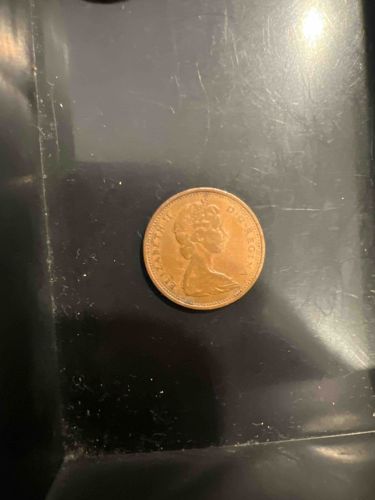
This item is a copper-colored coin, appearing to be a British One Penny coin, featuring a portrait of Queen Elizabeth II. The obverse depicts the youthful uncrowned effigy of Queen Elizabeth II, facing right, as designed by Mary Gillick. The inscription "ELIZABETH II D:G:REG:F:D." is visible around the rim, though some letters are slightly obscured by wear and the angle of the photograph. The coin exhibits a circular shape with a reeded edge, common for this denomination. The material appears to be bronze or a bronze-plated steel, consistent with penny coinage from the mid to late 20th century in the UK. Physical characteristics show a moderate amount of circulation wear, evidenced by softening of the high points on the Queen's effigy and some abrasions on the field. There are no obvious severe damages like deep scratches or significant dents, but fine scratching and surface grime are present across the visible surface, suggesting typical handling and environmental exposure over time. The overall color is a dull reddish-brown, indicative of aged copper or bronze, possibly with some toning. The lack of a visible date prevents precise dating, but the portrait style suggests a period from 1953 to early 1960s. The craftsmanship appears standard for mass-produced currency, with clear detail in the surviving features, despite the wear. There are no discernible unique markings or unusual aspects beyond typical coinage features.

AI Appraisal Report

·AI can make mistakes·Verify before acting
Based on my visual examination of the provided image, this British One Penny coin features the Mary Gillick effigy of Queen Elizabeth II. The authenticity for this common issue is not in question, as it aligns perfectly with known examples of the type. The coin is copper-colored, circular, and exhibits a reeded edge, all standard for this denomination. In terms of condition, I would rate it as Good (G) to Very Good (VG) on the Sheldon scale. There is moderate circulation wear, as evidenced by the softening of high points on the Queen's effigy and general field abrasions. Fine scratching and surface grime are present across the visible surface, consistent with typical handling over time. The overall color is a dull reddish-brown, typical of aged bronze. The lack of a visible date makes precise dating impossible from the image alone, but the portrait style definitively places it between 1953 and 1968 (pre-decimalization). These early Elizabeth II pennies are extremely common. Market conditions for circulated examples are very low, with most being worth little more than face value, if that. Demand is minimal among collectors for circulated examples, given their vast availability. There are no factors present that would significantly impact its value upwards; conversely, the wear and commonality significantly suppress it. The primary limitation in authenticity verification from an image alone is typically relevant for rarer or more valuable items, where specific die markers or subtle details are critical. For this common penny, the visual evidence is sufficient to confirm its identity as a standard issue. A physical inspection would allow for precise dating if visible, a more accurate condition assessment, and weight/measurement verification, though these are unlikely to alter the low valuation significantly for such a common coin.

Get your items appraised

Instant estimates of your treasures with AI-powered appraisals

Browse More Appraisals