These notes were written by the person who submitted this item. Appraiser.AI has not verified them, and the AI's identification and estimate may rely on them.
AI Estimated Value
Not an official valuation
$30 - $60
AI estimate as of September 16, 2025 · verify with a professional before acting
AI-Generated · Verify before acting
Everything on this page is generated by AI for informational purposes only. AI can make mistakes — the AI may misidentify items or misattribute them (artist, maker, brand, designer, origin, era). This is not an official valuation and should not be used for insurance, sale, tax, estate, legal, or lending purposes — or any decision requiring a certified appraisal. It is not an authoritative claim about any person, brand, or rights holder — do not share or rely on it as a factual statement about a third party. Always consult qualified professionals before making financial decisions.
This analysis also relies on unverified notes provided by the user, which may be incomplete or inaccurate and could affect the result.
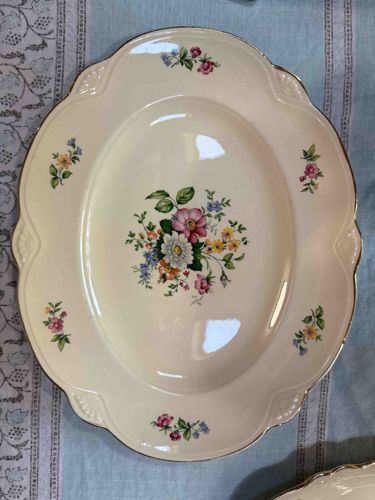
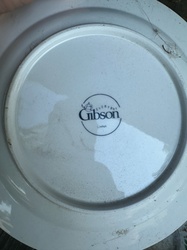
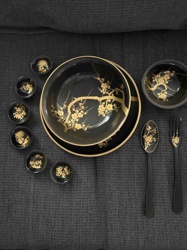
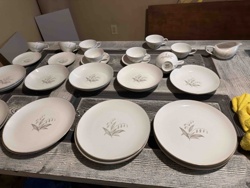
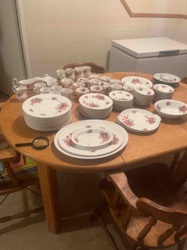
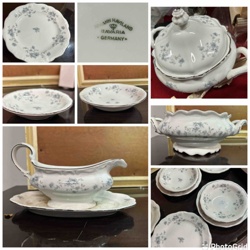
This is an oval-shaped serving platter, likely made of ceramic or semi-vitreous porcelain, manufactured by Homer Laughlin. The central part of the platter is recessed, forming an oval well, while the rim is significantly wider and features a scalloped edge with rococo-inspired embossed scrollwork and shell motifs at various points along the perimeter. The primary color of the platter is a creamy off-white or ivory, characteristic of Homer Laughlin's Georgian Eggshell line. The surface has a glossy glaze, reflecting light and indicating a well-preserved finish. Decorating the platter are vibrant floral transferware designs. A large, elaborate bouquet of colorful flowers and greenery is centrally placed within the oval well, featuring shades of pink, yellow, blue, white, and orange. Smaller, complementary floral sprigs are scattered strategically on the wide rim of the platter. The edges of the platter, including the scalloped details, are trimmed with a metallic gold band, which appears largely intact with minimal visible wear, suggesting careful handling or light use. The design style is distinctly traditional, possibly mid-20th century, consistent with the Georgian or Victorian-revival aesthetics popular during that era. The context 'Homer Laughlin C 48 N 8 platter' suggests the manufacturing year of 1948 and plant number 8, making it a vintage piece. No significant condition issues like chips, cracks, or heavy crazing are visible from the provided images, indicating good to excellent condition for its age. The craftsmanship appears to be typical of mass-produced dinnerware of its time, offering decorative appeal and functionality.
AI Appraisal Report
I have carefully examined the provided images and details for this Homer Laughlin C 48 N 8 platter in the Georgian Eggshell 'Brittany' Pattern. My assessment of its condition is excellent, given its age. I see no visible chips, cracks, or significant crazing, and the glossy glaze appears well-preserved. The gold trim, often a point of wear, seems largely intact, suggesting careful handling. The elaborate transferware floral designs are vibrant and show no signs of fading or damage. The 'C 48 N 8' mark points to a manufacturing date of 1948 from Plant 8, confirming its vintage status.
From a market perspective, Homer Laughlin dinnerware, while collectible, is generally not considered high-value antique porcelain unless it's a particularly rare pattern or form. The Georgian Eggshell line was a mass-produced, durable product. The 'Brittany' pattern is attractive and exemplifies the traditional mid-century aesthetic. Demand for such pieces is steady among collectors of vintage dinnerware and those seeking complementary pieces for existing sets. However, it is not a highly sought-after rarity that commands premium prices.
Comparables in similar condition, patterns, and forms typically sell in the range I've provided. Factors significantly impacting its value include its pristine condition and the appealing floral design. Without physical handling, I cannot definitively verify the absence of hairline cracks, minor imperfections not visible in photographs, or the precise feel of the glaze and weight, which can indicate authenticity and quality. Furthermore, I cannot conduct a hands-on examination for any repairs or restorations that might have been expertly done. Proper provenance or scientific testing would require an in-person assessment by an expert in Homer Laughlin dinnerware.