These notes were written by the person who submitted this item. Appraiser.AI has not verified them, and the AI's identification and estimate may rely on them.
AI Estimated Value
Not an official valuation
$40 - $70
AI estimate as of September 18, 2025 · verify with a professional before acting
AI-Generated · Verify before acting
Everything on this page is generated by AI for informational purposes only. AI can make mistakes — the AI may misidentify items or misattribute them (artist, maker, brand, designer, origin, era). This is not an official valuation and should not be used for insurance, sale, tax, estate, legal, or lending purposes — or any decision requiring a certified appraisal. It is not an authoritative claim about any person, brand, or rights holder — do not share or rely on it as a factual statement about a third party. Always consult qualified professionals before making financial decisions.
This analysis also relies on unverified notes provided by the user, which may be incomplete or inaccurate and could affect the result.
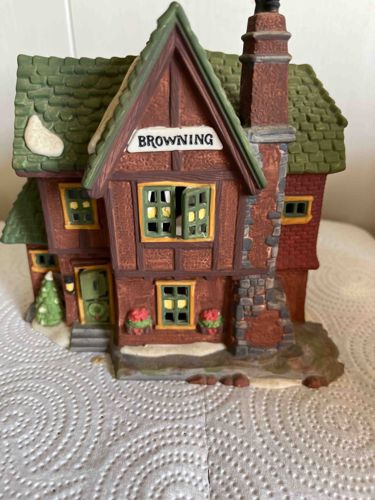
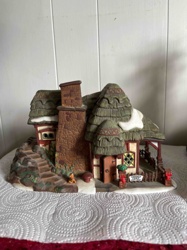
This item is a ceramic decorative house from the Department 56 Dickens' Village Series, specifically identified as 'Browning' by the sign affixed to the front gable. The item depicts a multi-story, Tudor-style building with a reddish-brown timber-frame facade and a textured, moss-green shingled roof, lightly dusted with 'snow' accents, particularly on the left slope. The facade features exposed dark brown timber framing over a reddish-brown base. Windows are present throughout, with square panes and lime-green frames, some of which appear to be artistically 'opened' to reveal a yellow-orange glow from within, simulating interior lighting. The front entrance has a lime-green door with a simple wreath and a small covered porch. To the left of the door, a small, frosted evergreen tree (possibly a Christmas tree) stands. On the lower level facade, two potted red flowers adorn the window sills. A prominent stone-textured chimney, constructed from varying shades of grey and brown, rises on the right side of the building, culminating in a black chimney pot. The base of the house is beige with faint, sculpted outlines suggesting a snowy ground cover. The overall construction is ceramic, hand-painted with a somewhat rustic finish consistent with collectible village pieces. It displays good craftsmanship with attention to architectural details. No obvious damage such as chips, cracks, or repairs are visible from the provided images, indicating a well-preserved condition. The hand-painted details, such as the textured roof, stone chimney, and faux snow, demonstrate a quality typical of Department 56 village pieces, designed to evoke a festive, historical, or quaint atmosphere.
AI Appraisal Report
I have examined the provided images of this Department 56 Dickens' Village Series 'Browning' House. The item appears to be in excellent condition, with no visible chips, cracks, or repairs, and its hand-painted details, including the textured roof, 'snow' accents, and illuminated windows, are well-preserved. Authenticity as a Department 56 piece is visually supported by its characteristic style and visible 'Browning' sign, typical of the series. However, the owner stated 'Department 55,' which is an error; it is clearly a Department 56 item. This discrepancy highlights the limitations of image-based appraisal; an in-person examination would verify the base stamp for definitive authenticity and series identification, and confirm the absence of subtle damages or repairs not visible here. Also, I would usually examine the electrical components to ensure they function safely and properly.
Market analysis for Department 56 Dickens' Village pieces shows a generally stable, but not rapidly appreciating, market. Items like the 'Browning' House are readily available from secondary sellers. While popular, they rarely command high prices unless they are retired, rare, or exceptionally large/detailed pieces from earlier production years. Individual houses typically fall within the $40-$70 range, with demand driven by collectors completing sets or new enthusiasts starting their villages. This particular piece appears to be a good example of its type, but without unique rarity or exceptional features, its value aligns with current market trends for well-maintained, common village buildings.